By Lin Wei, Plasma Applications Engineer. Works with medical device manufacturers on plasma cleaning and surface-activation process validation, including IQ/OQ/PQ protocols and biocompatibility documentation aligned with ISO 10993, on batch chambers ranging up to the RD-200 series.
A contract manufacturer producing Class II and Class III devices integrated plasma treatment for medical devices — low-pressure plasma cleaning — into its production workflow and saw part rejection rates drop from roughly 12% to just over 7% — a 40% reduction — within 90 days. The cause had been invisible: sub-micron organic residue left behind by machining oils and handling, which caused adhesive bond failures, inconsistent coatings, and failed biocompatibility retests.
Industrial plasma treatment differs from platelet-rich plasma (PRP) therapy — the injectable therapy derived from a patient's own blood, used for joint pain, hair loss, or skin rejuvenation. In manufacturing, plasma treatment uses an ionized gas to clean and activate device surfaces before bonding, coating, or sealing; it has no clinical or therapeutic effect on the human body. Plasma treatment for medical devices means removing molecular contamination and raising surface energy on components — a quality-control step, not a patient treatment.
Three fields share the word "plasma" but do different jobs. Low-temperature H2O2 plasma sterilization ionizes hydrogen peroxide vapor to inactivate microorganisms on a finished, packaged device — a terminal sterilization step, not a surface-prep step. Cold atmospheric plasma (CAP) research applies plasma directly to living tissue for wound healing or oncology studies — a clinical research field, not a manufacturing process. The plasma cleaning and activation in this case study happens earlier in production, on bare polymer or metal components, to remove contamination and raise surface energy before bonding, coating, or sealing.
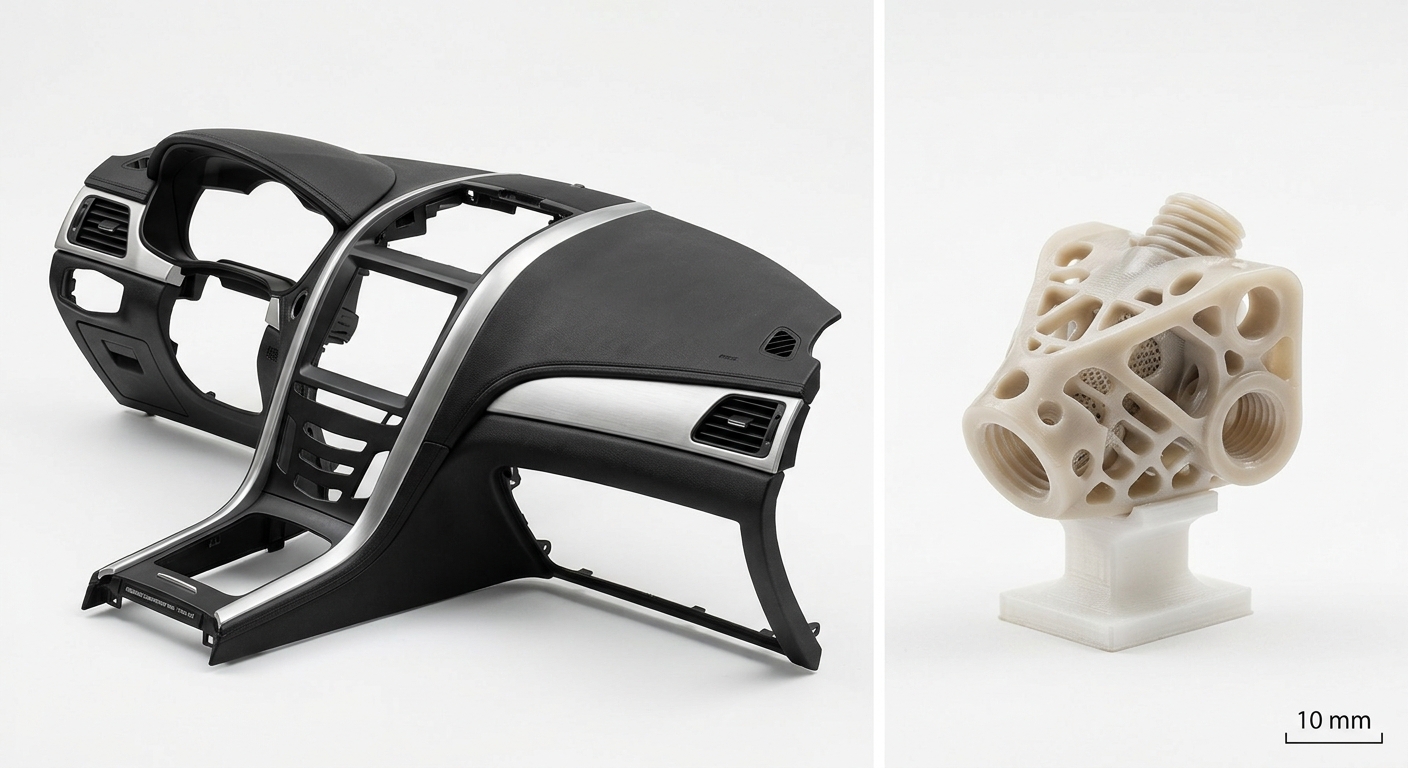
This facility produced polymer and metal-polymer hybrid components — catheter housings, sensor enclosures, and implantable connector assemblies. Their existing protocol was a three-step manual solvent wipe: isopropyl alcohol, acetone, then a deionized water rinse. Parts passed visual inspection, but rejection data told a different story:
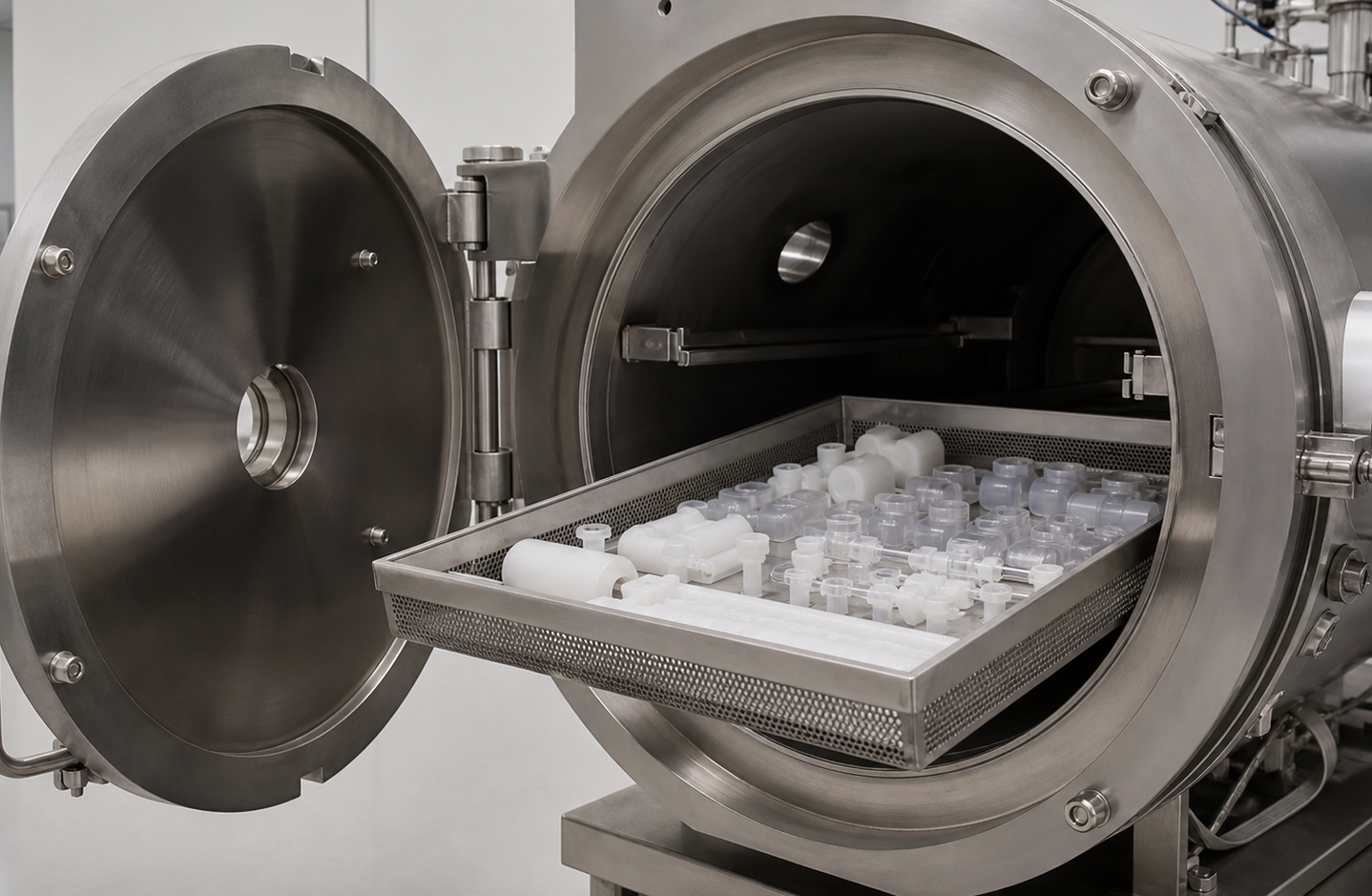
XPS surface analysis on "clean" parts found carbon contamination layers averaging 4–8 nanometers thick — invisible to the eye, devastating to surface chemistry. Solvents dissolve and displace bulk contaminants, but they can't break the molecular bonds of a chemisorbed organic layer. Worse, as solvent evaporates it can redeposit dissolved residue as a thin, uniform film across the whole part.
For components with silicone or elastomer subassemblies, the same contamination mechanism affects bond strength at the material interface — see PDMS Bonding with Oxygen Plasma: A Practical Guide for how oxygen plasma changes silicone surface chemistry specifically. The team confirmed the diagnosis by comparing methods in Dyne Ink vs Contact Angle vs XPS, settling on contact angle goniometry as the fastest routine check once XPS had identified the root cause.
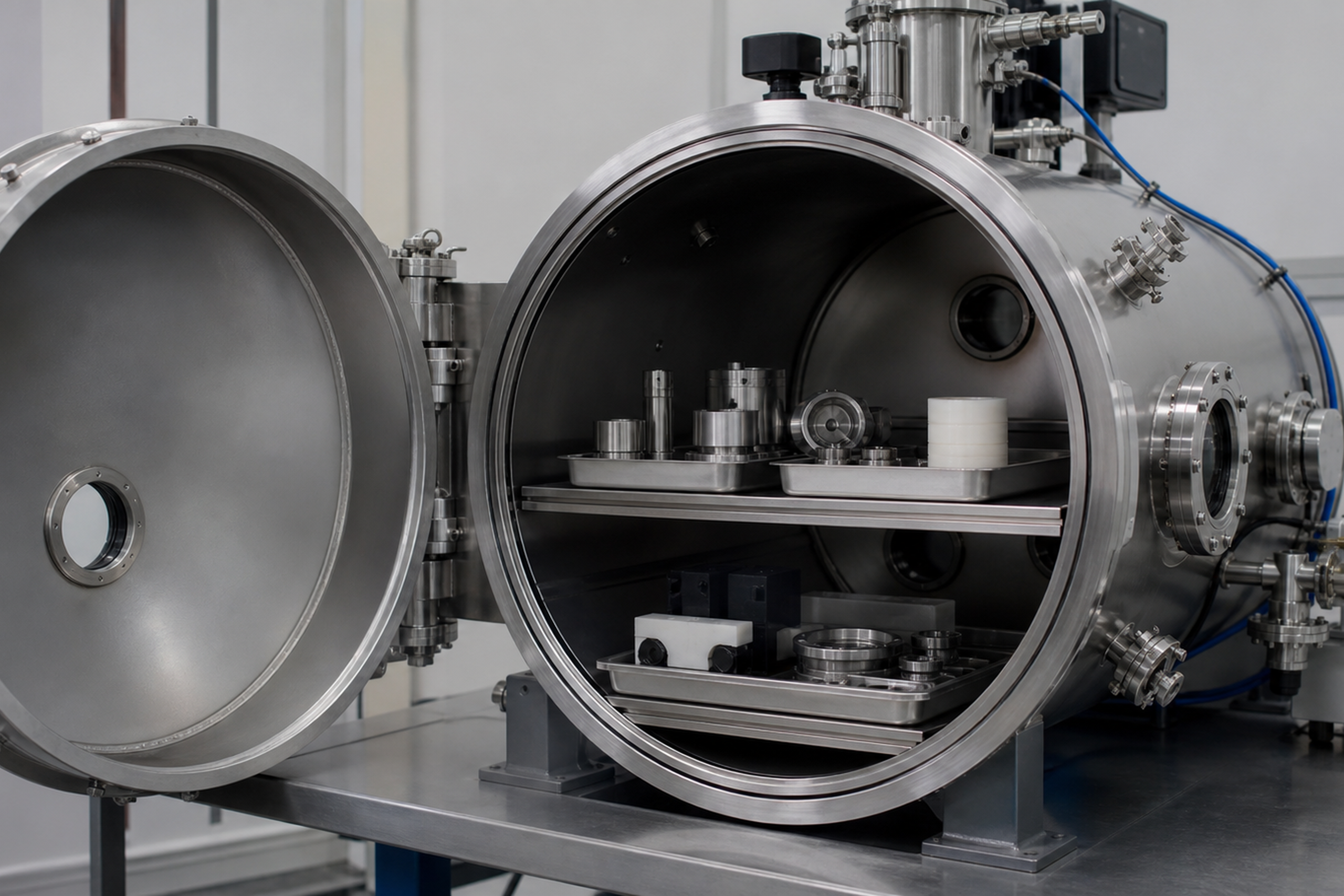
The facility installed a low-pressure plasma system running an 80% O₂ / 20% Ar gas mixture, processing parts in batch loads of up to 80 components per cycle at 300W RF and 0.3 mbar. Cycle time was 90 seconds — a fraction of the 12-minute manual protocol it partially replaced.
Reactive oxygen species chemically convert carbon-based residue into volatile byproducts (CO₂, H₂O) pumped out of the chamber — molecular removal, not displacement. Post-treatment XPS showed carbon layers fall from 4–8 nm to below 0.5 nm. The plasma simultaneously introduces polar functional groups onto the polymer, raising surface energy from a pre-treatment 28–34 dyne/cm to 52–68 dyne/cm.
Surface energy became the primary process output metric, measured via Contact Angle Measurement After Plasma on witness coupons included in every batch. Acceptance criteria: ≥50 dyne/cm on all polymer surfaces. Validation followed an IQ/OQ/PQ protocol; across 30 consecutive qualification batches, no batch fell below 54 dyne/cm — the traceability record needed alongside ISO 10993 biocompatibility documentation. The general mechanism behind these readings is laid out in Plasma Surface Treatment Explained.
| Metric | Before Plasma | After Plasma |
|---|---|---|
| Overall rejection rate | ~12% | ~7% (–40%) |
| Adhesive bond failures/batch | 8–15 | 0–3 |
| Coating adhesion failures | baseline | –60% |
| Biocompatibility retest frequency | every 3rd lot | every 8th lot |
| Shift-to-shift variability | 3× spread | effectively eliminated |
The 90-second plasma cycle also replaced two of the three manual solvent steps — operators kept a single IPA pre-wipe for gross contamination but dropped acetone and DI rinse entirely, cutting net cleaning time per batch by over 70%. Monthly solvent use fell from ~180 liters to ~40 liters. The same causal pattern — contamination hiding behind a passing visual check — shows up outside medical manufacturing too, including a plasma treatment for electronics case where scrap dropped 34%.
Over the first 12 months, the manufacturer tracked savings against the process change:
Total first-year savings: approximately $225,000, recovering the system's cost in under 7 months. Ongoing operating cost (process gas, electricity, annual maintenance) runs roughly $4,500/year after payback. A similar cost-versus-defect trade-off plays out in Eliminate Primer Coats with Inline Plasma, where an entire pre-treatment chemistry step was removed rather than reduced. Current plasma cleaning machine options give a sense of where capital cost typically lands for batch systems in this range.
Check these before committing:
The next step for plasma treatment for medical devices evaluation is usually a small feasibility run on your own parts, measuring bond strength or coating adhesion before and after treatment — talk it through with the fariplasmatech team.
Does plasma treatment actually work for medical device manufacturing?
In the case above, it dropped rejections 40% within 90 days by removing a sub-micron organic layer that solvent cleaning couldn't touch. It works reliably when the failure mode is molecular contamination or low surface energy — not when parts have gross machining debris still on them.
How long does plasma treatment last on a treated surface?
Plasma-activated surfaces don't stay activated indefinitely. Surface energy decays through "hydrophobic recovery" as ambient contaminants re-adsorb, typically over a window from 30 minutes to 48 hours depending on the polymer. Bonding or coating soon after treatment, not a shift later, preserves the gain.
What are the risks of plasma treatment for medical-grade materials?
The main risk is over-treatment: excessive power or dwell time can micro-etch or embrittle sensitive polymers beyond the intended activation effect. Running validated parameters (power, gas ratio, cycle time) with witness-coupon monitoring on every batch keeps the process inside safe limits.
What are plasma treatments used for in medical device production?
Three main jobs: cleaning (removing organic residue before bonding or sealing), surface activation (raising surface energy for adhesives, coatings, and inks), and ashing (stripping photoresist or organic films in component manufacturing).
Is plasma treatment the same as plasma therapy (PRP)?
No. PRP is a blood-derived injection therapy used in clinics for injuries and cosmetic procedures. Industrial plasma treatment is a dry, ionized-gas manufacturing process used to clean and prepare device surfaces before bonding, coating, or sealing — the two share a name but nothing else.


English

Spanish
Rogatus ad ultimum admissusque in consistorium ambage nulla praegressa inconsiderate