Atmospheric plasma treatment has emerged as a revolutionary technology in modern manufacturing and materials processing. Unlike traditional surface treatment methods that require complex vacuum systems or harsh chemical processes, atmospheric plasma treatment operates at normal air pressure.
Plasma is often referred to as the "fourth state of matter," existing alongside solids, liquids, and gases. When ordinary gas is ionized—meaning electrons are stripped away from atoms—it becomes plasma, a collection of ions, electrons, and neutral particles. Atmospheric plasma specifically refers to plasma generated and maintained at normal atmospheric pressure, rather than in a vacuum chamber.
In atmospheric plasma treatment systems, energy is applied to ambient air (or another working gas) to create this ionized state. This energy source ionizes gas molecules, creating highly reactive species including ions, electrons, excited atoms, and free radicals. These reactive components are what make atmospheric plasma such a powerful treatment tool.
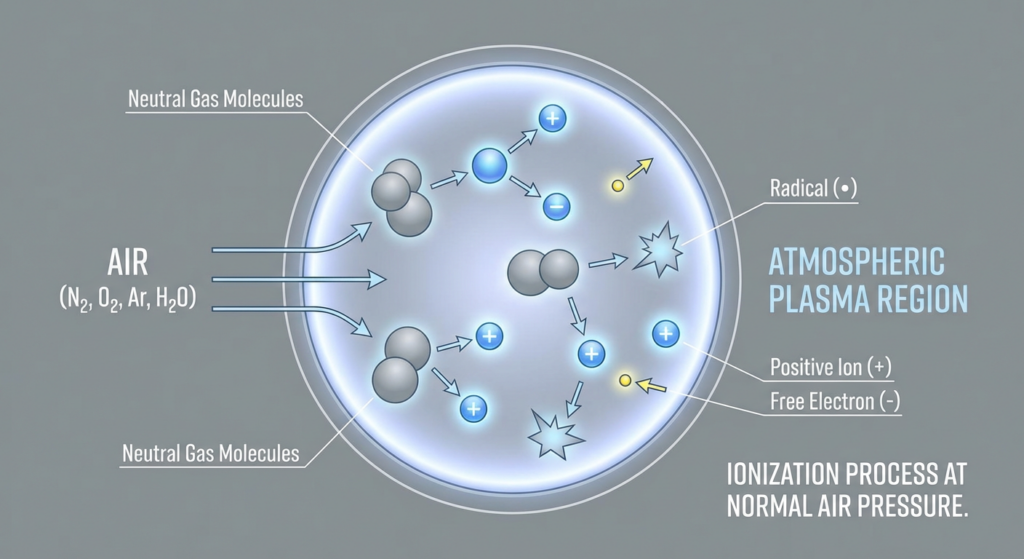
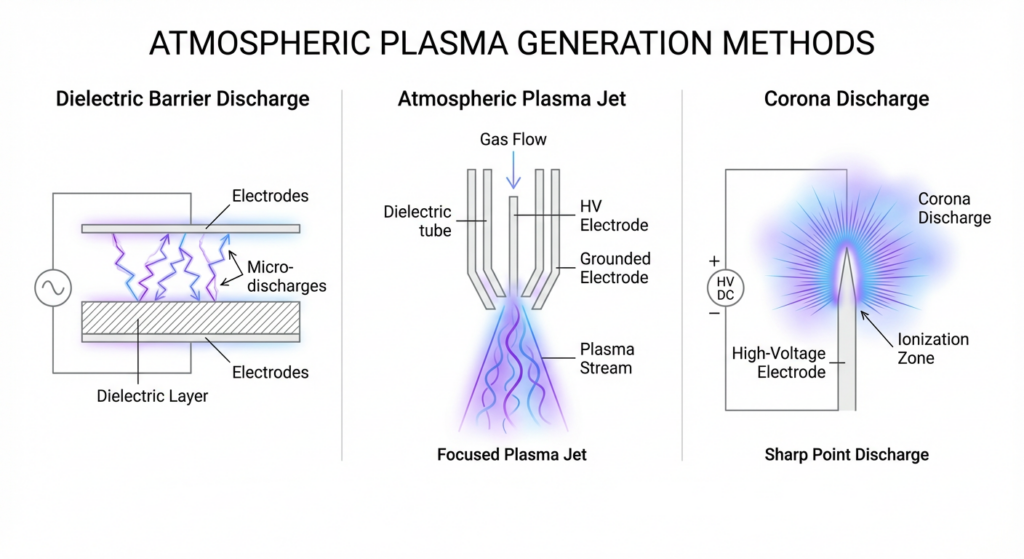
Atmospheric plasma treatment systems typically generate plasma through one of several methods:
Dielectric Barrier Discharge (DBD): This is the most common approach for atmospheric plasma generation. DBD systems use an electric field between two electrodes separated by a dielectric material. When high voltage is applied, the gas breaks down into plasma at specific locations, creating numerous micro-discharges. This method is particularly effective because it prevents the formation of a single large arc, instead creating a diffuse, uniform plasma.
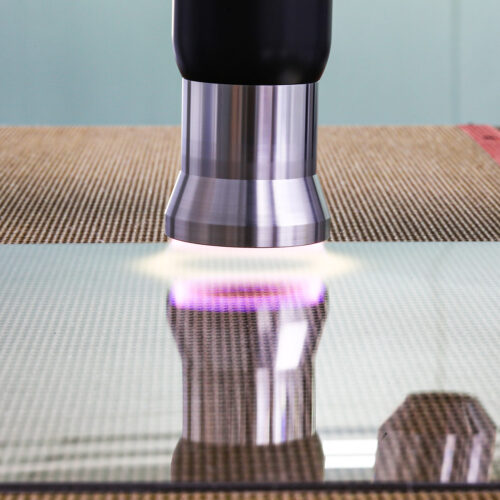
Atmospheric Pressure Plasma Jets (APPJ): These systems generate plasma in a confined region and direct it as a jet toward the target surface. This approach allows for precise treatment of specific areas and is ideal for sensitive or complex geometries.
Corona Discharge: This method uses a high-voltage electrode to ionize air, creating a corona effect. The resulting plasma can be applied to surfaces for various treatment purposes.
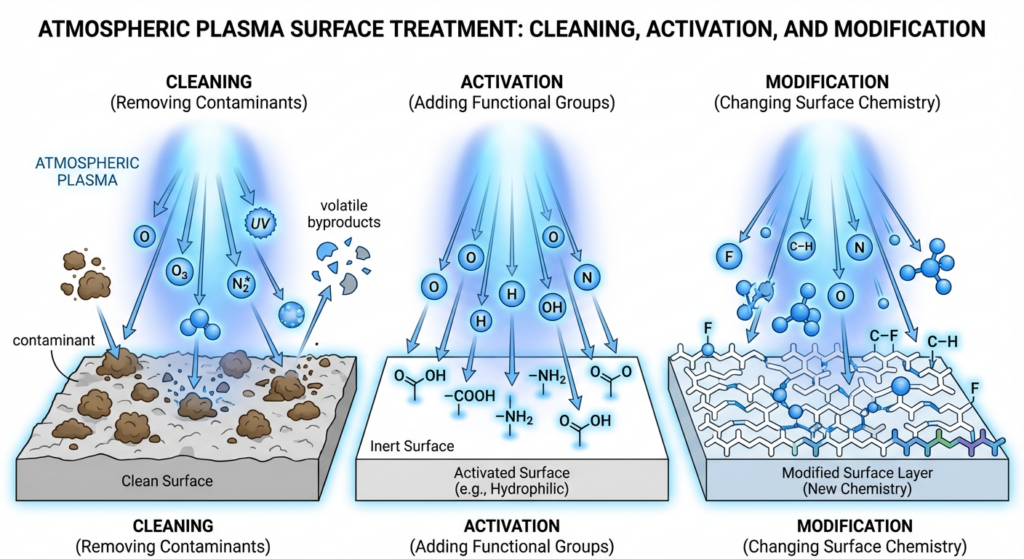
Once plasma is generated, its reactive components interact with the target material's surface through several key mechanisms:
Surface Cleaning: Energetic ions and free radicals remove organic contaminants, oxides, and other surface impurities. This is far more effective than mechanical scrubbing and doesn't require liquid chemicals.
Surface Activation: Plasma treatment creates reactive functional groups on the material surface. For polymers, this increases surface energy and wettability, improving adhesion for subsequent bonding, coating, or printing applications.
Surface Modification: The plasma modifies the chemical composition of the top molecular layers. This can improve properties like hydrophilicity (water attraction) or create specific surface characteristics needed for particular applications.
Sterilization: In applications requiring sanitization, the reactive species in plasma effectively eliminate bacteria, viruses, and other microorganisms, making it valuable for medical and food processing applications.
Unlike many traditional surface treatment methods, atmospheric plasma treatment:
Treatment times are typically measured in seconds or fractions of a second, enabling high-speed inline processing. This makes atmospheric plasma particularly attractive for high-volume manufacturing environments where productivity directly impacts profitability.
Both atmospheric plasma and low-pressure plasma can improve surface adhesion, wettability, and cleanliness. However, they are designed for different production environments. For most manufacturers, the main decision comes down to production speed, equipment footprint, part geometry, and integration cost.
| Factor | Atmospheric Plasma | Low-Pressure Plasma |
|---|---|---|
| Operating pressure | Ambient air pressure | 0.1–10 mbar |
| Processing method | Continuous inline treatment | Batch treatment inside a vacuum chamber |
| Throughput | High, suitable for automated production lines | Lower, limited by chamber loading and cycle time |
| Equipment footprint | Compact system with no vacuum chamber required | Larger chamber, pump system, and supporting equipment |
| Part size limit | No chamber-volume restriction | Limited by vacuum chamber size |
| Complex geometry handling | Best for flat, open, and accessible surfaces | Better for enclosed cavities and internal surfaces |
| Capital cost | Lower | Higher |
| Best suited for | Adhesion preparation, surface activation, inline cleaning, printing, bonding, and coating | Precision etching, enclosed surface treatment, and highly uniform chamber processing |
For industrial bonding preparation, coating adhesion improvement, printing pretreatment, and inline surface activation, atmospheric plasma is often the more practical choice. It can be integrated directly into production lines, requires less space, and avoids the cost and cycle time of vacuum processing.
Low-pressure plasma is more suitable when treatment needs to reach enclosed features, internal cavities, or complex three-dimensional surfaces that cannot be effectively accessed by an atmospheric plasma nozzle.
Atmospheric plasma surface treatment can be applied to a wide range of materials used in industrial manufacturing, including plastics, metals, glass, ceramics, composites, and flexible films.
Materials that are traditionally difficult to bond, such as PTFE, polyethylene, polypropylene, and silicone, can benefit significantly from plasma activation. After treatment, these substrates can reach higher surface energy levels, allowing adhesives, inks, coatings, and primers to spread more evenly across the surface.
For many bonding and coating applications, atmospheric plasma can help reduce reliance on chemical primers, flame treatment, or mechanical abrasion while supporting a cleaner and more controllable pretreatment process.
For engineers evaluating atmospheric plasma integration, the following ranges are commonly used as reference points for industrial surface treatment systems.
| Parameter | Typical Range | Notes |
|---|---|---|
| Treatment speed | 10–200 mm/s | Adjusted according to substrate type, nozzle design, and required surface energy |
| Standoff distance | 5–15 mm | Distance between the plasma nozzle and the substrate surface |
| Working gas | Compressed dry air, nitrogen, or argon | Compressed dry air is commonly used; nitrogen or argon may be selected for oxidation-sensitive materials |
| System power | 200 W to 1 kW | Depends on throughput, nozzle configuration, and treatment width |
| Achievable surface energy | 38–72 mN/m | Varies by material, surface condition, and treatment settings |
On glass and many metal surfaces, atmospheric plasma can produce very low contact angles, indicating strong surface wetting. Engineering polymers typically reach surface energy levels suitable for bonding, printing, coating, and laminating after a properly controlled plasma pass.
The final result depends on several factors, including substrate chemistry, contamination level, nozzle distance, treatment speed, gas type, and time between plasma treatment and downstream processing. For best results, plasma parameters should be validated through contact angle testing, dyne testing, or application-specific adhesion testing before full production use.
The effectiveness of atmospheric plasma treatment stems from the synergistic action of multiple reactive species. These include:
This multi-faceted attack on surface contamination and surface properties is why plasma treatment often outperforms single-mechanism treatment approaches.
Atmospheric plasma treatment represents a paradigm shift in surface processing technology. By harnessing the unique properties of ionized gas at normal pressure, manufacturers can achieve superior surface preparation, activation, and modification while reducing environmental impact and operational costs. As industries worldwide face increasing pressure to improve product quality while maintaining sustainability, atmospheric plasma treatment has proven to be a transformative technology that meets both demands.



English

Spanish
Rogatus ad ultimum admissusque in consistorium ambage nulla praegressa inconsiderate