TPE toy plasma treatment is a dry surface-preparation process used before printing, spray painting, coating and adhesive bonding. It can remove or modify thin surface contamination while increasing the surface energy of thermoplastic elastomer components.
This is particularly useful for soft animal figures, educational toys, flexible molded parts and other TPE products with curved surfaces, recessed details and textured areas. These parts may retain mold-release agents, lubricants or migrated additives that interfere with ink and adhesive wetting.
Plasma treatment does not replace correct material selection, ink compatibility or final toy-safety testing. However, when the process is developed using the actual TPE compound, coating and production conditions, it can help manufacturers achieve more repeatable printing and bonding results.
This guide explains why TPE surfaces are difficult to print, how plasma activation works, how to select a treatment system and how to validate the finished process.
Thermoplastic elastomer, abbreviated as TPE, describes a family of materials that combine rubber-like flexibility with thermoplastic processing characteristics. Depending on the compound, TPE can be injection molded, extruded or overmolded into soft components with detailed shapes.
Common TPE toy products include:
The term TPE covers many different chemical formulations. Their hardness, additive package, surface energy, heat resistance and response to plasma treatment can vary substantially. A recipe developed for one TPE grade should not automatically be transferred to another grade without testing.
Learn more about industrial plasma treatment for plastics and rubber .
Many TPE compounds have relatively low surface energy. As a result, ink, paint or adhesive may form beads, retract from the surface or spread unevenly instead of creating consistent contact.
Poor wetting can cause incomplete graphics, weak paint adhesion, edge lifting or bonding failure even when the selected ink or adhesive performs well on higher-energy plastics.
Injection molding may leave traces of mold-release agents, lubricants, oil, dust or other processing residues on the toy surface. These materials can form a weak boundary layer between the TPE and the applied ink, coating or adhesive.
Contamination can also be introduced by handling, storage trays, gloves, packaging, compressed air or silicone-containing products used elsewhere in the workshop.
Some TPE compounds contain oils, plasticizers, slip additives or other ingredients that may migrate toward the surface over time. Plasma can clean and activate the surface present at the time of treatment, but it cannot permanently prevent further migration from within an unsuitable material formulation.
Animal figures and molded toys often contain curved bodies, recessed eyes, textured fur, narrow gaps, undercuts and detailed patterns. Manual wiping or a line-of-sight treatment method may not prepare all areas uniformly.
Thin or highly flexible parts may distort under excessive heat, mechanical pressure or aggressive treatment. The process must therefore provide enough surface modification without causing whitening, embrittlement, deformation or unwanted changes in appearance.
A plasma system energizes a selected process gas to produce electrons, ions, radicals and excited molecules. These reactive species interact with only the outermost region of the TPE surface under controlled conditions.
Depending on the TPE formulation, gas chemistry and treatment recipe, plasma processing may provide three related effects.
Reactive plasma species can break down thin organic residues such as light oils, fingerprints and mold-release contamination. Volatile reaction products are removed from the process area or evacuated from a vacuum chamber.
Plasma cleaning is not a substitute for removing thick grease, visible debris or severe contamination. Parts with heavy deposits may require a separate preliminary cleaning process.
Read more about plasma cleaning technology .
Plasma treatment can introduce polar oxygen- or nitrogen-containing functional groups, depending on the selected gas and material chemistry. These groups increase surface energy and can improve the ability of inks, coatings and adhesives to wet the surface.
Better wetting helps the applied material form more continuous contact with the TPE. However, final adhesion also depends on ink chemistry, curing conditions, coating thickness and the compatibility of the complete material system.
See how plasma surface activation improves adhesion .
Some plasma recipes create limited micro-scale changes in surface topography. This may increase the available contact area and support mechanical interlocking.
The effect depends on the polymer and treatment conditions. Excessive etching is not desirable for a finished toy surface because it may alter gloss, color, texture or tactile properties.
Important: plasma treatment modifies the surface rather than the bulk of the material. Nevertheless, excessive power, treatment time or part temperature can affect sensitive TPE compounds. Appearance, hardness and flexibility should be checked during process validation.
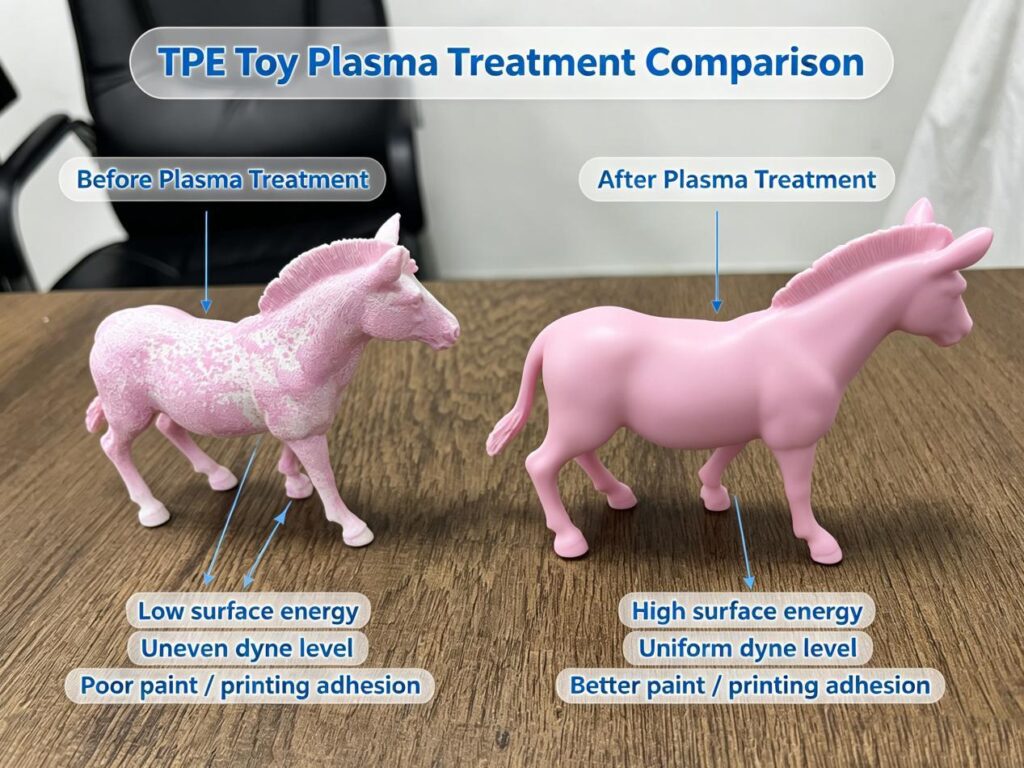
Increasing surface energy can help liquid ink or paint spread more uniformly across molded TPE surfaces. This may reduce dewetting, pinholes, edge retraction and incomplete coverage.
Removing weak surface contamination and activating the polymer can improve adhesion for pad printing, spray coating, selected digital printing processes and other decoration methods.
Plasma treatment may also prepare TPE components before bonding them to compatible plastics, fabrics, decorative pieces or other toy components. Adhesive selection and joint design must still be validated independently.
Plasma processing can reduce dependence on wet solvent wiping for suitable applications. This can simplify drying and reduce the risk of leaving cleaning-liquid residue, although extraction and process safety requirements still need to be considered.
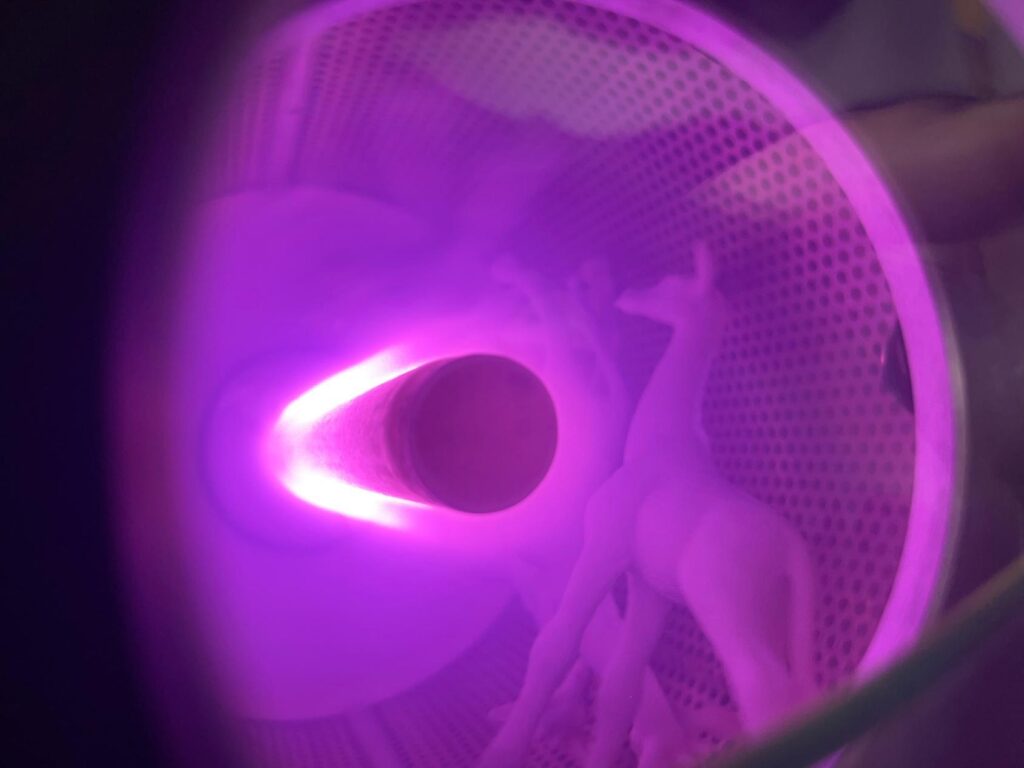
Vacuum plasma can surround exposed surfaces, while a rotating drum can continually change part orientation. These approaches can be useful for batches of small, irregular components that are difficult to treat using a fixed line-of-sight process.
Systems with controlled power, gas flow, pressure, treatment time and recipe storage can reduce operator-dependent variation. Repeatability still requires consistent incoming materials, loading arrangements and downstream processing.
Record the material supplier, grade, hardness, color, molding conditions and additive package where available. Different TPE families can respond differently to oxygen, air, argon or nitrogen plasma.
If the compound is changed, the surface-treatment recipe and ink system should be rechecked rather than assuming equivalent performance.
Determine whether the treated part will be pad printed, spray painted, coated, glued or overmolded. Record the ink, coating, primer or adhesive specification as well as its application and curing conditions.
Plasma treatment should be optimized for the complete material system rather than for an arbitrary dyne value alone.
Remove loose particles and visible contamination before plasma treatment. Confirm that the parts are dry and have reached a consistent condition after molding.
Use clean gloves and handling tools. Avoid silicone sprays, oily compressed air and contaminated storage trays near the treatment and printing areas.
Choose a fixed vacuum chamber, rotary drum vacuum system or atmospheric plasma unit based on the part geometry, production volume and areas requiring treatment.
The primary recipe variables include:
Begin with controlled trials and change one parameter at a time. The correct recipe is the lowest practical treatment dose that repeatedly meets the required adhesion test without affecting the toy surface.
Avoid overfilling a chamber or drum. Parts that remain pressed together may shield contacting areas from the plasma. Tangling, nesting and restricted rotation can also create uneven treatment.
Record the number and weight of parts per batch, carrier position and drum speed so that the same loading condition can be reproduced.
Activated polymer surfaces may gradually lose part of their increased surface energy through aging, contamination or additive migration. Complete the downstream operation as soon as practical after treatment.
If storage is unavoidable, determine an acceptable treatment-to-printing window through testing under the actual packaging, temperature and humidity conditions.
Apply and cure the ink, paint or adhesive according to the supplier’s instructions. Evaluate adhesion only after the specified curing period. Immediate tape testing may not represent the performance of a coating that requires additional drying or chemical cure.
| Treatment System | Best Suited For | Main Advantages | Important Limitations |
|---|---|---|---|
| Fixed-Chamber Vacuum Plasma | Delicate toys, positioned components and parts that must not rub together | Controlled gas chemistry, full-chamber treatment and repeatable batch recipes | Fixtures and touching surfaces may create treatment shadows |
| Rotary Drum Vacuum Plasma | Small irregular TPE figures and bulk molded components | Continually changes part orientation and exposes multiple sides during treatment | Part-to-part contact may mark fragile surfaces or damage delicate features |
| Atmospheric Plasma | Accessible surfaces, selected decoration areas and automated production lines | No vacuum cycle and easier integration into continuous manufacturing | Recesses, undercuts and hidden areas require careful nozzle-path validation |
For an overview of available batch systems, explore vacuum plasma cleaners .
| Variable | Why It Matters | Recommended Control |
|---|---|---|
| TPE formulation | Different polymers, oils and additives respond differently to plasma | Record the material grade and revalidate after compound changes |
| Surface contamination | Mold release, oil and dust can block direct ink or adhesive contact | Control molding, handling, storage and preliminary cleaning |
| Process gas | Gas chemistry affects cleaning, functional groups and etching behavior | Compare approved gases using the actual TPE and downstream material |
| Plasma power | Insufficient power may under-treat; excessive power may affect appearance | Establish an operating window instead of using maximum power |
| Treatment time | Determines the total plasma dose received by the part | Test several exposure levels while keeping other variables constant |
| Part temperature | Some soft compounds may distort or change appearance when overheated | Measure the actual part temperature during process development |
| Drum speed | Affects part movement, exposure uniformity and mechanical contact | Balance surface exposure against the risk of part damage |
| Batch quantity | Overloading may create shielding, nesting or non-uniform treatment | Define a repeatable maximum load by part count or total weight |
| Treatment-to-print delay | Surface energy may decrease through aging and contamination | Print or bond promptly and validate any required storage window |
| Ink and curing process | Plasma cannot correct an incompatible ink or incomplete cure | Validate plasma, ink, application and curing as one process |
Dyne pens or test inks can provide a quick indication of surface wetting. Use fresh, compatible test liquids and follow a standardized procedure because operator technique can influence the result.
A dyne result should be treated as a process indicator rather than proof of final coating adhesion.
Contact angle measurement provides a more quantitative comparison of untreated and treated samples. Lower liquid contact angles generally indicate improved wetting, but the result does not replace finished-product adhesion testing.
Apply the actual coating, allow it to cure and evaluate whether the coating detaches under a defined cutting and tape procedure. The test method, tape, curing period and operator technique should remain consistent.
Toy graphics may experience repeated touching, rubbing, packaging contact and cleaning. Use a controlled rub or abrasion test that represents the intended product conditions.
For bonded components, use a defined peel, pull or tensile test. Record the failure mode: adhesive failure at the TPE interface, cohesive failure within the adhesive or deformation of the TPE provide different information about the joint.
Evaluate finished parts after relevant temperature, humidity and storage conditions. Some coatings perform well immediately after printing but lose adhesion after additive migration or environmental exposure.
Compliance note: plasma treatment is a manufacturing process, not a toy safety certification. The manufacturer must still validate the complete TPE compound, colorant, ink, coating, adhesive and finished toy against the requirements of the target market.
Possible causes include:
First confirm the incoming surface condition, treatment-to-printing time and ink curing process. Avoid increasing plasma power before checking whether the ink is chemically compatible with the TPE.
Uneven adhesion may result from recessed features, parts touching each other, fixed contact points, insufficient drum movement or an atmospheric nozzle path that does not cover the complete printing area.
Use dyne or contact-angle measurements at several locations. Adjust part orientation, loading quantity, fixtures, drum speed or nozzle path as required.
Check whether the drum or chamber is overloaded. Parts may nest together, remain trapped beneath other components or receive different exposure because of weight and geometry.
Define the batch using both part count and total weight. Confirm that parts can move freely without creating excessive mechanical damage.
Visible or tactile changes may indicate excessive treatment intensity, excessive exposure, unwanted etching or excessive part temperature.
Reduce the treatment dose and evaluate an alternative gas recipe. Confirm the result using color, gloss, hardness and tactile comparisons rather than visual inspection alone.
This may be caused by surface aging, airborne contamination or continued migration of oils and additives from within the TPE.
Shorten the delay before printing and test the material after realistic storage. If migration continues after treatment, consult the TPE and ink suppliers about a more compatible compound or coating system.
Even materials sold under the same general TPE description may contain different polymer ratios, fillers, pigments or additives. Record supplier batch information and include incoming-material checks in the production control plan.
Potential applications include surface preparation before:
Additional information about ink and coating preparation is available on the plasma treatment for packaging and printing application page.
Determine whether the treatment area is flat, externally accessible, recessed or distributed around the complete toy. Complex all-around surfaces may require a different system from one localized printing area.
A rotary drum provides changing orientation but also causes parts to contact the drum and one another. Thin projections, soft painted surfaces and delicate details may require a fixed carrier instead.
Record the number of parts required per hour, available cycle time and permitted work-in-process inventory. A laboratory system may be appropriate for recipe development, while industrial production may require a larger drum or automated line.
Adjustable power, gas flow, pressure, process time and drum speed allow the treatment to be adapted to different TPE compounds. Recipe storage and monitoring support more consistent production.
The RD-10 rotary drum vacuum plasma cleaner uses a rotating reaction chamber to expose small powders, particles and irregular components to low-pressure plasma.
For TPE toy applications, sample trials should confirm that the rotation improves exposure without scratching, deforming or tangling the parts.
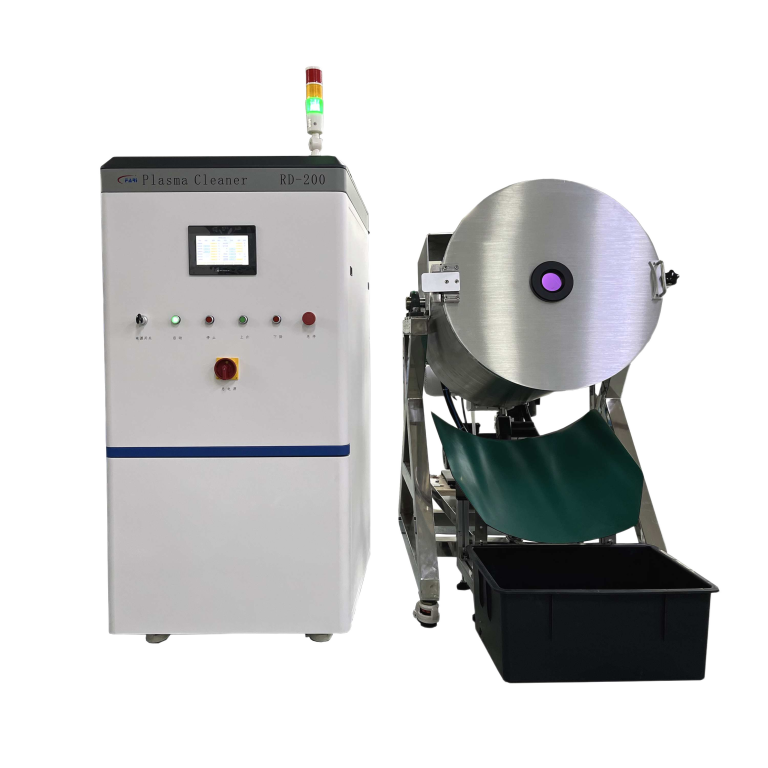
The RD-200 large vacuum drum plasma cleaner is intended for larger industrial batches of bulk and complex components. Batch capacity should be confirmed using the actual toy dimensions, weight and required movement inside the chamber.
Chamber dimensions, drum structure, carriers, plasma power, gas-flow control and automation interfaces may need to be configured around a specific toy production line.
Explore custom plasma equipment and process matching for non-standard batch sizes or automation requirements.
A reliable plasma process should be developed using the actual TPE compound, molded geometry, contamination condition, ink or adhesive and production cycle.
Provide the following information when requesting an evaluation:
Contact Fari Plasma to discuss sample evaluation, process development and equipment selection for TPE toy printing, coating or bonding.
Many TPE compounds have low surface energy and may contain mold-release residue, oils or migrating additives. These conditions reduce ink wetting and can create a weak layer between the coating and the TPE.
Plasma can remove or modify thin organic surface residues under suitable process conditions. It may not be sufficient for thick contamination or for additives that continually migrate from within the TPE compound.
Plasma primarily acts on the surface, so an optimized process may preserve the bulk flexibility and hardness of the TPE. Excessive treatment can still affect appearance or surface feel, so the actual material must be tested.
Neither method is universally better. Vacuum plasma is useful for controlled batch treatment and complex exposed surfaces. Atmospheric plasma is often suitable for localized treatment and inline production. The decision depends on geometry, throughput and the required treatment area.
The effective treatment window depends on the TPE formulation, plasma recipe, environment and storage conditions. Printing or bonding should normally be completed as soon as practical, and any required storage period should be validated.
A rotary drum can change part orientation and improve exposure of multiple surfaces. Uniformity depends on drum loading, rotation, part geometry and whether components become nested or remain in contact. Fragile features must also be checked for mechanical damage.
No. Plasma improves surface preparation, but final performance also depends on the TPE compound, paint or ink compatibility, application thickness, curing process and product environment.
No. Plasma treatment does not certify a finished toy. The manufacturer must test the complete material, coating, adhesive and product against the applicable requirements in each target market.




English

Spanish
Rogatus ad ultimum admissusque in consistorium ambage nulla praegressa inconsiderate