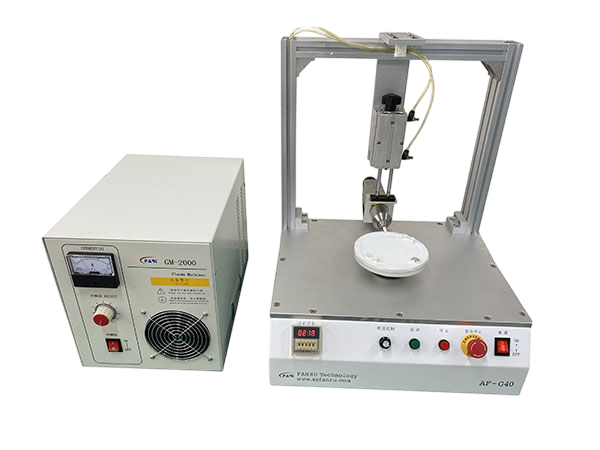
AF-G40 is a bench-top rotary platform plasma treatment machine designed for circular components and regular round materials. Its rotating worktable provides stable 360-degree plasma exposure across the treatment area, helping achieve uniform surface activation for bonding, coating, printing, and assembly preparation. As part of Fari Plasma's atmospheric plasma systems range, this model is a compact configuration for parts that require controlled rotation rather than conveyor-based inline processing. For a full overview of how atmospheric plasma surface treatment works, see our technology guide.
| Input Voltage | AC220 V |
| Output Power | 1.5KW |
| Processing Height | 8-12 mm |
| Processing Width | 300 mm |
| Size(L*W*H) | 450*400*620mm |
| Gas Used | Air, N2(optional) |
| Transmission Speed | 9-10 m/min |


Process gas is energized and converted into a reactive plasma containing ions, electrons, and radicals.

Energetic plasma species interact with surface molecules and contaminants under controlled vacuum conditions.

Reactive ions and radicals break down organic residues and surface contaminants through controlled chemical reactions.

The reaction products are converted into volatile compounds and enter the gas phase.

Gaseous by-products desorb from the surface and are evacuated, leaving a clean, activated material surface.


English

Spanish
Rogatus ad ultimum admissusque in consistorium ambage nulla praegressa inconsiderate