If you need a fast go/no-go check on the production line, dyne inks are fine. If you need defensible, quantitative data for process validation, use contact angle goniometry. And if you’re chasing a mysterious adhesion failure down to the molecular level, nothing beats XPS. The honest answer is that these three methods aren’t competitors — they’re different tools for different questions, and the biggest mistake engineers make is trying to use one when they actually need another.
Before we get into the weeds, let’s define what each method actually does — because the terminology gets sloppy fast.
Dyne inks (also called surface tension test fluids or Accudyne pens) are calibrated liquid mixtures that wet or dewet a surface based on its surface energy. You swipe the ink across the substrate and watch whether it beads up (low energy) or spreads into a continuous film (high energy). It’s essentially a crude titration.
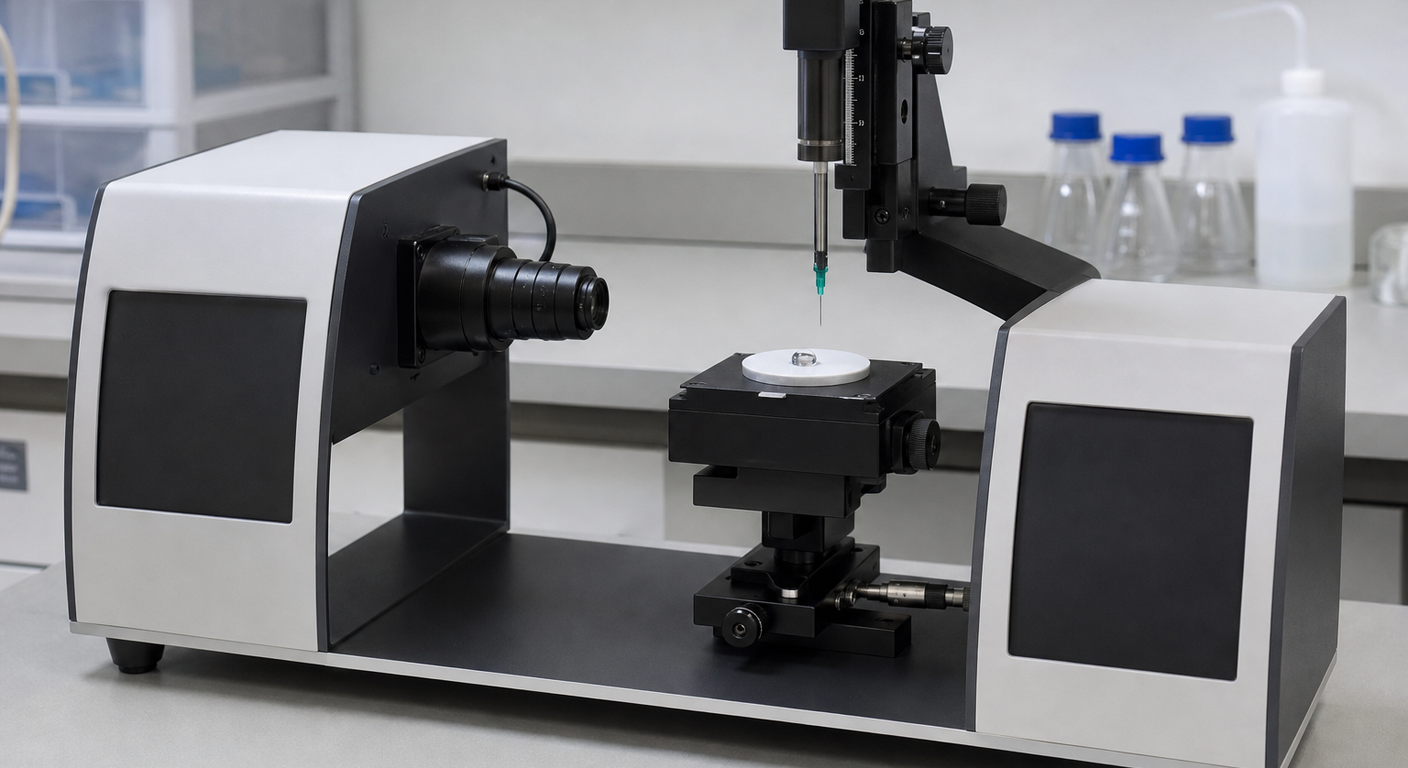
Contact angle measurement uses a goniometer or drop-shape analyzer to put a precisely sized droplet (usually deionized water, sometimes diiodomethane or ethylene glycol) on the surface, then photographs the droplet profile. The angle between the liquid and the solid tells you wettability, and with two or more test liquids you can calculate surface free energy using the Owens-Wendt or Wu model.
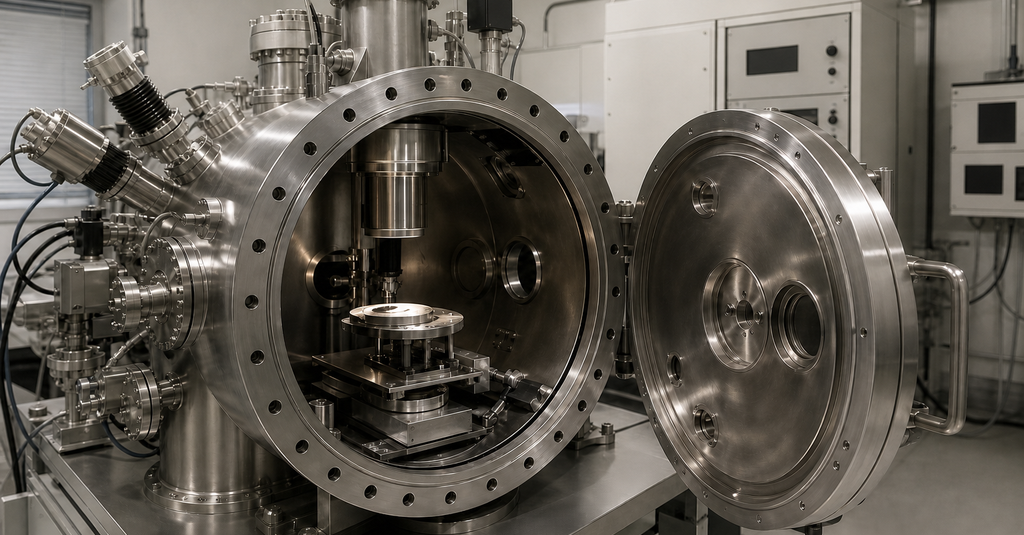
XPS (X-ray Photoelectron Spectroscopy), sometimes called ESCA, bombards the surface with X-rays in ultra-high vacuum and measures the kinetic energy of ejected electrons. It tells you exactly which elements are present in the top 5–10 nanometers, at what concentration, and — crucially — in what chemical state (C-C vs. C-O vs. C=O, for example).
One measures how a liquid behaves on the surface. One quantifies that behavior. One tells you why it’s behaving that way. See the difference?
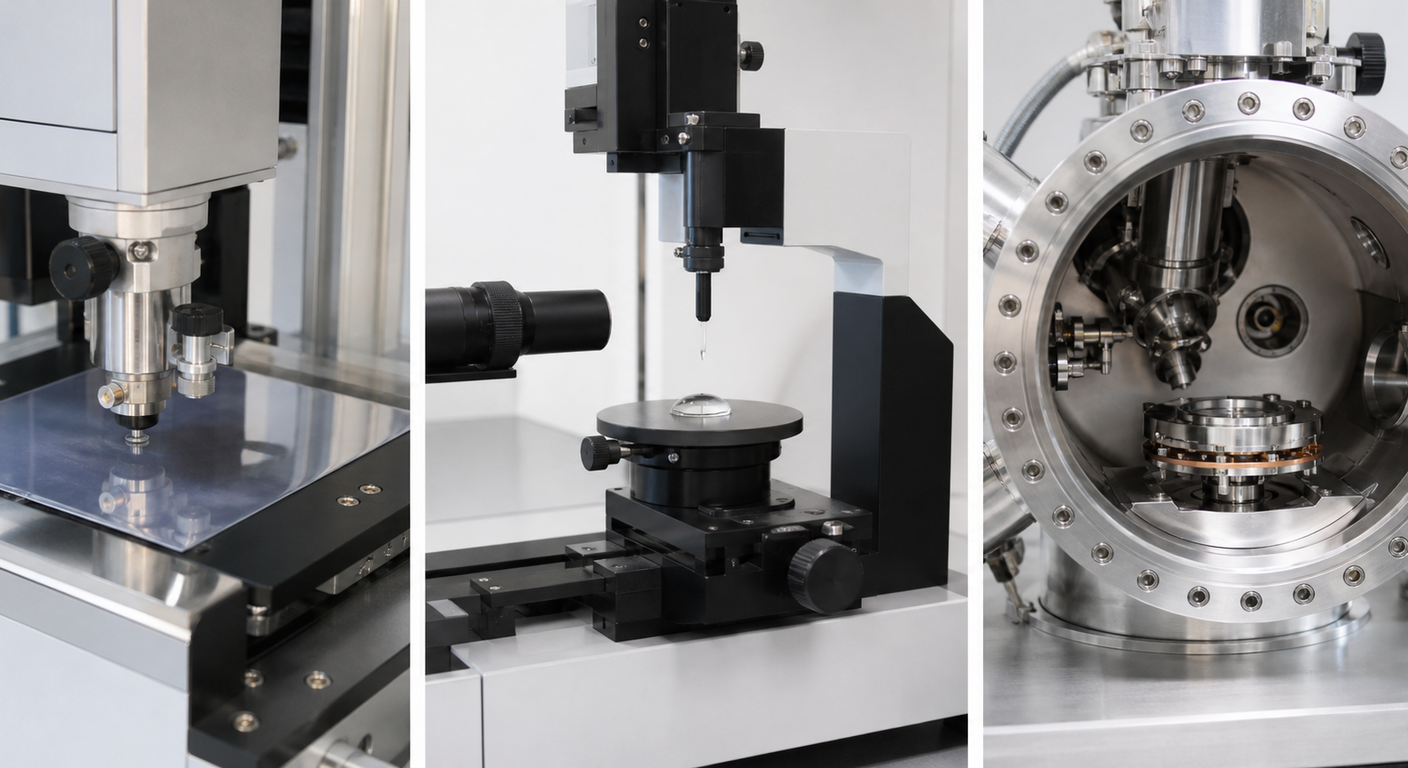
Dyne inks have earned their spot on nearly every plasma-treated packaging line for one reason: speed. An operator can check a web of corona- or plasma-treated PP film in under ten seconds. At roughly $0.20 per test, you can check every roll without flinching at the cost.
But here’s what the data sheets don’t emphasize: dyne inks are indirect, interpretive, and contaminating. The test relies on an operator’s visual judgment of whether a liquid film holds continuous for 2 seconds — and that judgment drifts between shifts, lighting conditions, and humidity. Studies have shown operator-to-operator variation of ±4 mN/m on the same sample, which is larger than the dyne level increments themselves.
They also expire. Dyne fluids oxidize once opened, and a bottle older than 6 months can read 4–6 mN/m low. If your QC team is pulling from a bottle with no date on it, you don’t have a measurement — you have a ritual.
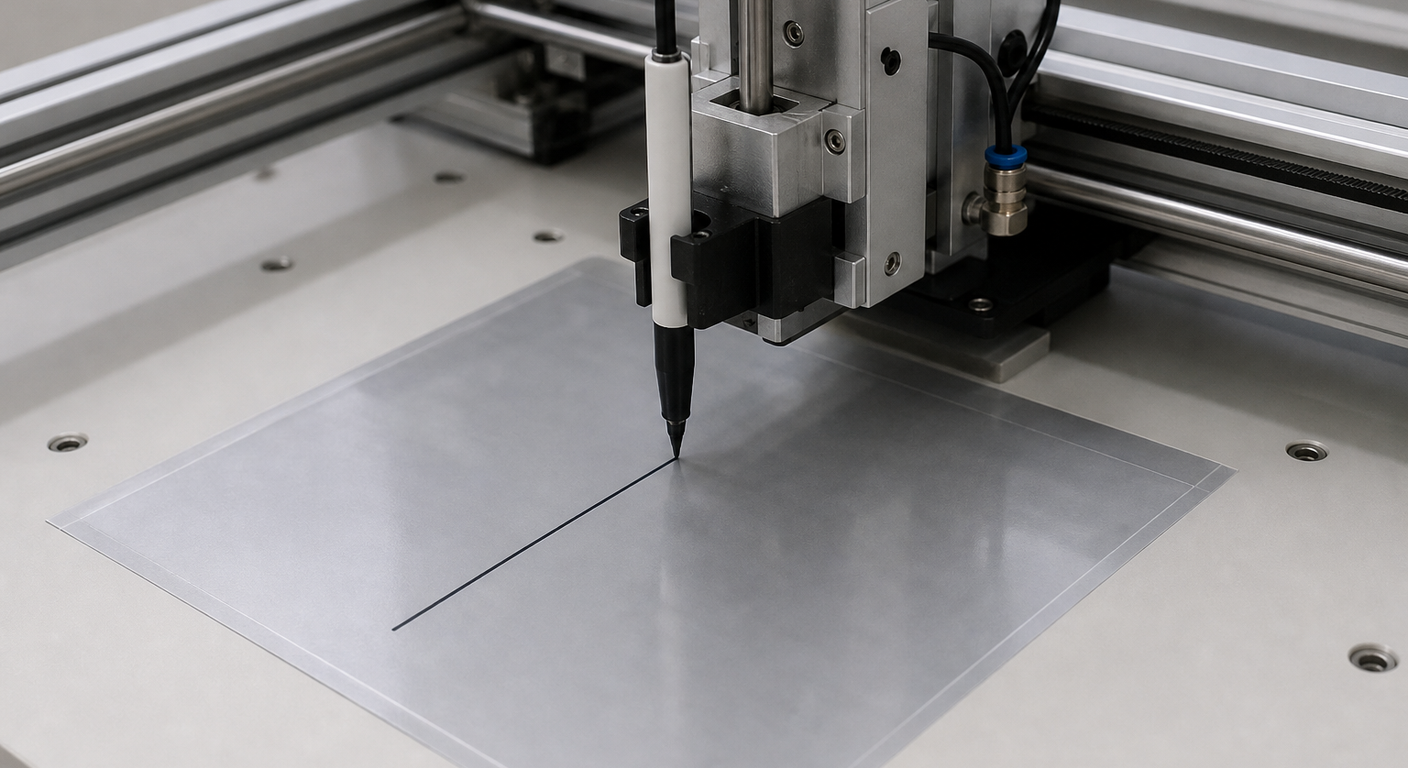
If dyne inks are a bathroom scale, contact angle measurement is a calibrated lab balance. You get a number, not a judgment call. A sessile drop goniometer with automated drop-shape fitting can resolve contact angles to ±0.5°, which translates to roughly ±0.5 mN/m in calculated surface energy — about four times tighter than a dyne kit.
The method also gives you something dyne inks physically cannot: polar and dispersive components of surface energy. Plasma treatment often doesn’t change total surface energy dramatically — it shifts the ratio of polar to dispersive contributions by introducing oxygen-containing functional groups. A film might go from 38 mN/m (mostly dispersive) to 52 mN/m with 18 mN/m polar component after plasma. Dyne inks see only the total. Contact angle sees the shift that actually drives adhesion.
A real-world example: a flexible electronics manufacturer we worked with was shipping OLED encapsulation films that passed 46 dyne ink consistently, yet delamination rates climbed to 3.2%. Contact angle analysis with water and diiodomethane revealed the polar component had quietly dropped from 14 mN/m to 6 mN/m as their plasma electrode aged. Dyne inks missed it entirely. A goniometer picked it up in one shift.
For anyone running plasma process development, contact angle is non-negotiable. Our technology and knowledge resources cover the Owens-Wendt calculation in more depth, and our capabilities lab uses dual-liquid goniometry for every process validation we ship.
Neither dyne inks nor contact angle can tell you what is on a surface. They measure consequences, not causes. XPS measures the cause directly.
Here’s what makes XPS uniquely powerful for plasma work: after a proper oxygen plasma treatment on polyethylene, you should see the C1s peak deconvolute into components at 285.0 eV (C-C), 286.5 eV (C-O), 288.0 eV (C=O), and 289.0 eV (O-C=O). The ratio of these peaks tells you exactly which functional groups the plasma grafted onto the surface — and at what density. Typical post-plasma O/C atomic ratios climb from ~0.02 on untreated PE to 0.20–0.35 depending on gas chemistry and dose.
XPS is also the only method that can diagnose hydrophobic recovery at the molecular level. When a plasma-treated surface loses activation over days or weeks, XPS shows polar groups reorienting into the bulk while low-molecular-weight aliphatic chains migrate outward. You see the chemistry change even when contact angle barely moves.
The downside is brutal: $200–$800 per sample, 30–90 minutes of instrument time, requires ultra-high vacuum, destroys the sample region analyzed, and interpretation genuinely requires a specialist. You don’t use XPS to qualify a production batch. You use it when something has gone wrong and you need to know why — or when you’re developing a new process and need to prove what the plasma is actually doing.
Here’s how the three methods stack up across the criteria that matter for day-to-day decisions:
| Criteria | Dyne Ink | Contact Angle | XPS |
|---|---|---|---|
| What it measures | Surface tension (approx.) | Wettability & surface energy | Elemental & chemical composition |
| Accuracy | ±2–4 mN/m | ±1–2° (≈±0.5 mN/m) | ±0.1 atomic % |
| Cost per test | $0.05–$0.50 | $5–$20 | $200–$800 |
| Time per sample | 10 seconds | 2–5 minutes | 30–90 minutes |
| Best for | Line-side QC | Process development | Root-cause analysis |
| Destructive? | Yes (contaminates) | Minimally | Yes (vacuum + X-ray) |
| Operator skill | Low | Medium | High (PhD-level) |
| Reveals chemistry? | ✗ | ✗ (indirect) | ✓ |
Notice the pattern: as you move right, you gain information depth and lose speed and affordability. There is no universally “best” method — only the best match for the question you’re trying to answer.
The smartest QC programs use all three in a layered way. Think of it like a medical triage: cheap-and-fast first, precise second, diagnostic third.
Dyne ink spot checks. The goal isn’t accurate measurement — it’s detecting that the treater is still doing something. A trending drop from 48 to 42 dyne is a warning sign worth investigating even if the spec says ≥40.
Contact angle measurement, ideally with two test liquids for surface energy component analysis. Run this monthly on a reference sample, and whenever you change plasma gas, power, or throughput. This is also what your customers’ quality auditors want to see when they ask for process capability data.
XPS, and only when something is genuinely wrong. An adhesion failure, a customer complaint, a new material that isn’t behaving, or a validation study for a regulated product (medical devices, aerospace, automotive safety components). Outsource it unless you’re running high enough volume to justify a ~$500K instrument.
A tier-1 automotive supplier we supported uses exactly this hierarchy: dyne checks every 500 parts, contact angle every shift on a witness coupon, and XPS once per quarter plus any customer complaint. Their adhesion failure rate dropped from 1.8% to under 0.2% over 18 months — not because they bought better plasma, but because they knew what each test could and couldn’t tell them.
Even the right method gives bad data if you use it wrong. The usual suspects:
If you’re seeing plasma performance that doesn’t match your test data, the problem is often measurement protocol, not the plasma. Our FAQ and whitepapers cover these pitfalls in more detail.
Trust all of them — for what they’re designed to measure. Distrust any single one used in isolation for a question outside its strengths.
If I had to pick one as the “most trustworthy” method for plasma treatment verification, it’s contact angle. It’s quantitative, reasonably priced, fast enough for routine use, and directly measures the property that determines adhesion. Dyne inks are a screening tool, not a measurement. XPS is a diagnostic microscope, not a QC method.
But the real win comes from using them together: dyne for breadth, contact angle for depth, XPS when you need to see the chemistry. That’s how world-class plasma process control actually works — not by finding a magic single test, but by matching the tool to the question.
If you’re designing a surface energy QC protocol for a new plasma-treated product, or trying to figure out why your adhesion data doesn’t match your dyne readings, our applications team has run these comparisons across polymers, metals, composites, and glass. Reach out through our contact page or browse the applications library to see how other manufacturers have structured their testing hierarchies. Getting the measurement right is the first step to getting the process right.



English

Spanish
Rogatus ad ultimum admissusque in consistorium ambage nulla praegressa inconsiderate