


Blog
Get The Latest Industry Trends
-
 Plasma BasicsPBT false eyelash fibers are difficult to bond when low surface energy and silicone processing residues prevent adhesive from wetting the root evenly. Vacuum plasma cleaning and activation can prepare the fiber surface without adding another wet-cleaning step.20 Oct, 2026Plasma Treatment for PBT False Eyelash Fibers: Improve Adhesive Bonding
-
Plasma BasicsMicroscopic organic contamination and photoresist residue can interfere with bonding, coating and advanced semiconductor packaging. Controlled plasma cleaning provides a dry precision step that complements wet cleaning before critical downstream processes.15 Oct, 2026Wafer Plasma Cleaning: Surface Preparation for Semiconductor Processing
-
Plasma BasicsTrace polishing residue, mold release and organic contamination can undermine coating and adhesive performance on smartphone camera lenses. Low-temperature plasma provides dry precision cleaning and surface activation before AR/AF coating or module bonding.08 Oct, 2026Plasma Cleaning for Smartphone Camera Lenses: Better Coating and Bonding
-
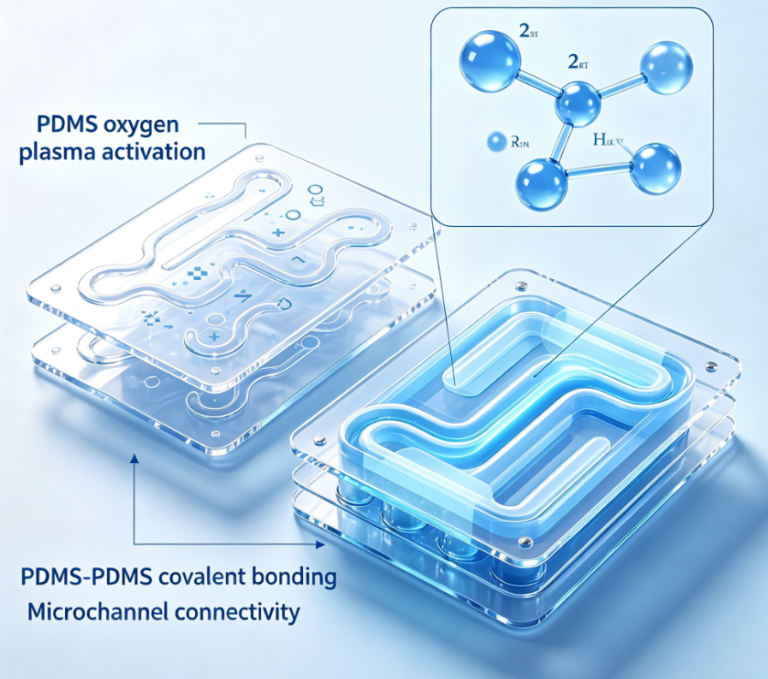
Plasma BasicsPlasma bonding is the use of plasma-generated surface activation to join two materials directly, at the molecular level, without adhesives, primers, or solvents. Engineers reach for it in medical microfluidics, silicon wafer bonding, silicone/elastomer device assembly, and anywhere an adhesive layer would add unwanted mass, outgassing, or a failure point.22 Sep, 2026Plasma Bonding Explained: How Plasma Enables Adhesive-Free Bonds
-
Plasma BasicsPlasma treatment doesn't coat, paint, or add mass to a surface. It rearranges the molecular chemistry of the outermost surface layer so adhesives, inks, and coatings wet out and bond instead of beading up. That shift — the plasma treatment surface energy increase — is the entire reason the plasma surface treatment process shows up in adhesion, printing, and bonding specs for plastics, metals, and glass.14 Sep, 2026Plasma Surface Treatment Explained: What It Actually Does and Why It Matters
-
Plasma BasicsAn inline plasma cleaner treats parts as they move continuously through a plasma zone — on a conveyor, robotic arm, or automated fixture — rather than loading a batch into a sealed chamber and running a fixed cycle. The format brings real throughput and automation benefits, but also real trade-offs worth weighing before committing capital to a line integration. Before deciding, compare it directly against the Inline Automatic Vacuum Plasma Cleaner to see whether continuous-feed treatment actually matches your part flow.04 Sep, 2026Inline Plasma Cleaner Pros and Cons: Advantages, Limitations & When to Use