Reviewed by the Fari Plasma Applications Engineering Team — engineers who run the company's in-house application laboratory and have specified atmospheric and vacuum plasma systems for industrial customers since 2011.
Atmospheric plasma is a partially ionized gas generated and sustained at, or close to, normal ambient air pressure — no vacuum chamber, no sealed pressure vessel required. It's also called AP plasma or normal-pressure plasma in technical literature, and the "atmospheric" part of the name is the whole point: it's the property that lets the gas be ionized right on a production floor instead of inside a pumped-down enclosure.
That single difference — no vacuum — is why atmospheric plasma shows up on conveyor lines, web-fed film processes, and robotic dispensing cells across electronics, automotive, medical device, and packaging manufacturing.
Plasma is often called the fourth state of matter: a gas that has had enough energy pumped into it that some of its molecules split into free electrons and ions, while still containing plenty of neutral gas. Under normal room conditions, air doesn't spontaneously do this — it takes an applied electric field to strip electrons off gas molecules and keep the resulting mix electrically active.
What separates atmospheric plasma from the plasma used in semiconductor fabs is pressure, not chemistry. Vacuum plasma is generated inside a chamber pumped down to a fraction of normal air pressure, which lets ionization happen at comparatively low voltage and produces a very uniform discharge. Atmospheric plasma skips the vacuum step entirely and ionizes gas at roughly the pressure already sitting in the room. The trade-off is that igniting and sustaining the discharge at full atmospheric pressure takes more careful electrode and power design than a vacuum chamber needs, since gas molecules are packed far more densely and want to collapse into a hot arc rather than settle into a stable glow.
To ionize any gas, you need to push it past its breakdown voltage — the point where an applied electric field rips electrons loose from gas molecules faster than they recombine. At low pressure, that breakdown voltage is easy to reach because gas molecules are spread further apart and collide less. At atmospheric pressure, molecules are packed much more densely, so a straightforward high-voltage DC field either needs a very small gap between electrodes or it tends to arc rather than form a stable, even plasma cloud.
In practice, atmospheric-pressure plasma equipment gets around this in two ways: by keeping the electrode gap small and precisely controlled, and by driving the electrodes with higher-frequency AC or pulsed power instead of steady DC. Higher frequency lets the discharge re-ionize the gas many times per second before it can collapse into a hot, localized arc, which keeps the plasma as a smooth, diffuse cloud rather than a lightning-like filament. This is the same basic principle used across DC plasma jets, dielectric barrier discharges, and microwave-excited jets — different hardware approaches to the same problem of sustaining stable ionization without a vacuum.
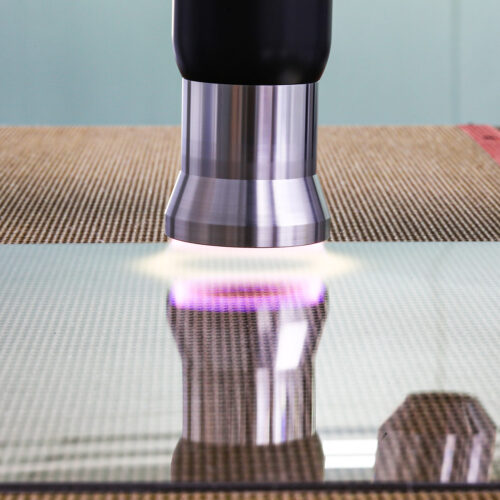
Excitation frequencies for this kind of discharge commonly run from around 10 kHz up to 100 kHz, with some RF-driven jet designs operating as high as 13.56 MHz — the higher end trading circuit complexity for a more stable, arc-free glow. Once ionized, the gas exits through a nozzle or jet head typically held a few millimeters to roughly 10–15 mm above the part, close enough that reactive species reach the surface before they recombine back into neutral gas in open air.
The gas itself is usually compressed air, since it's already available on any factory floor, though nitrogen, argon, and oxygen are also used when a process needs a specific chemical effect on the treated surface rather than just general cleaning. The gas flows through the discharge zone, picks up energy and reactive species, and is directed onto the part through a nozzle or jet head — which is the mechanism behind what's marketed as atmospheric-pressure plasma surface treatment.
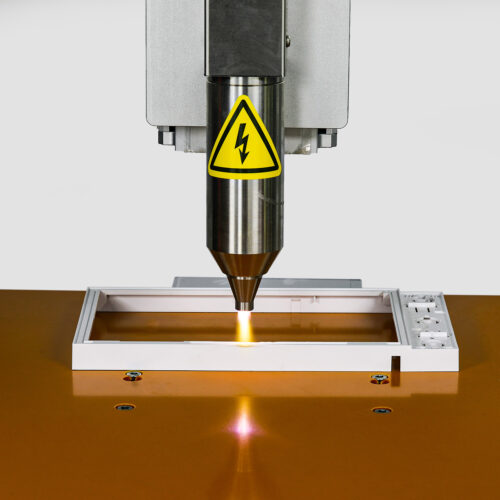
Both corona and atmospheric plasma ionize a gas to raise the surface energy of plastics and other low-adhesion substrates, but the geometry of the discharge itself is different. Corona's filamentary discharge concentrates ionization into discrete, thread-like channels scattered unevenly across the treated width — visible as tiny sparking filaments jumping between electrode and substrate. Atmospheric plasma's diffuse glow spreads that same ionization evenly across the discharge gap instead of concentrating it into filaments, so treatment lands more uniformly and etches the surface more consistently from edge to edge. That more even discharge geometry is also why plasma reaches deeper into the surface chemistry — etching plus activation — rather than corona's largely surface-level polarization effect, a distinction the corona vs. plasma comparison lays out in more detail, including how treatment durability differs between the two processes.
Atmospheric plasma runs inline at ambient pressure, which makes it a natural fit for continuous production — parts or webs move through the discharge zone without pausing for a chamber to pump down and vent. Vacuum plasma trades that speed for depth and uniformity: because the chamber is sealed and evacuated, the plasma can surround complex geometries more evenly, which matters for parts with recesses, internal channels, or dense assemblies that a line-of-sight atmospheric jet can't fully reach. Neither approach is universally "better" — line speed and part geometry usually decide which one fits. The atmospheric vs low-pressure plasma guide compares line-speed capacity, part-geometry limits, and chamber cycle times between the two approaches in detail, including the atmospheric options worth weighing for inline work.
Once the plasma jet contacts a part, it produces two effects that manufacturers actually care about. The first is cleaning: reactive species in the plasma break down organic residues, mold-release agents, and light oxidation on the surface without any liquid chemistry or rinse step. The second is activation: the same reactive bombardment raises the surface energy (often measured in dyne level) of the material, which is what lets adhesives, inks, coatings, and encapsulants wet out and bond properly instead of beading up or peeling off later.
Surface energy is usually checked with dyne test fluids calibrated to ASTM D2578, a graduated set of inks that wet out only above a specific dyne level. Untreated polypropylene or polyethylene typically reads around 29–31 dynes/cm; after atmospheric-pressure plasma exposure, the same surface commonly reads 40 dynes/cm or higher — comfortably past the roughly 38 dyne/cm threshold most water-based inks and adhesives need to wet out and bond reliably. That gain isn't permanent: surface energy starts dropping within hours of treatment and keeps declining over the following days as the surface reoxidizes in open air, which is why plasma treatment is positioned immediately before the bonding, coating, or printing step it's meant to support rather than earlier in the process. Contact angle measurement after plasma treatment tracks exactly this kind of decay curve.
These two effects are why atmospheric plasma treatment sits upstream of bonding, printing, coating, and sealing steps rather than replacing them — it prepares the surface, it doesn't apply anything to it. The mechanism, equipment configurations, and process parameters behind this are detailed on the Atmospheric Plasma Surface Treatment page.
For processes that run continuously rather than in batches, the absence of a vacuum chamber changes the economics of surface treatment:
That throughput advantage shows up in measured outcomes, not just theory. In one documented case, a consumer electronics manufacturer that moved an inline cleaning step to atmospheric-pressure plasma cut assembly scrap tied to adhesion failures by 34%, processing boards continuously through the line instead of batching them through a chamber — full details are in the consumer electronics scrap-rate case study.
A concrete example of this kind of integration is atmospheric plasma treatment for wire and cable, where the plasma jet treats insulation or jacketing as it feeds continuously through the line.
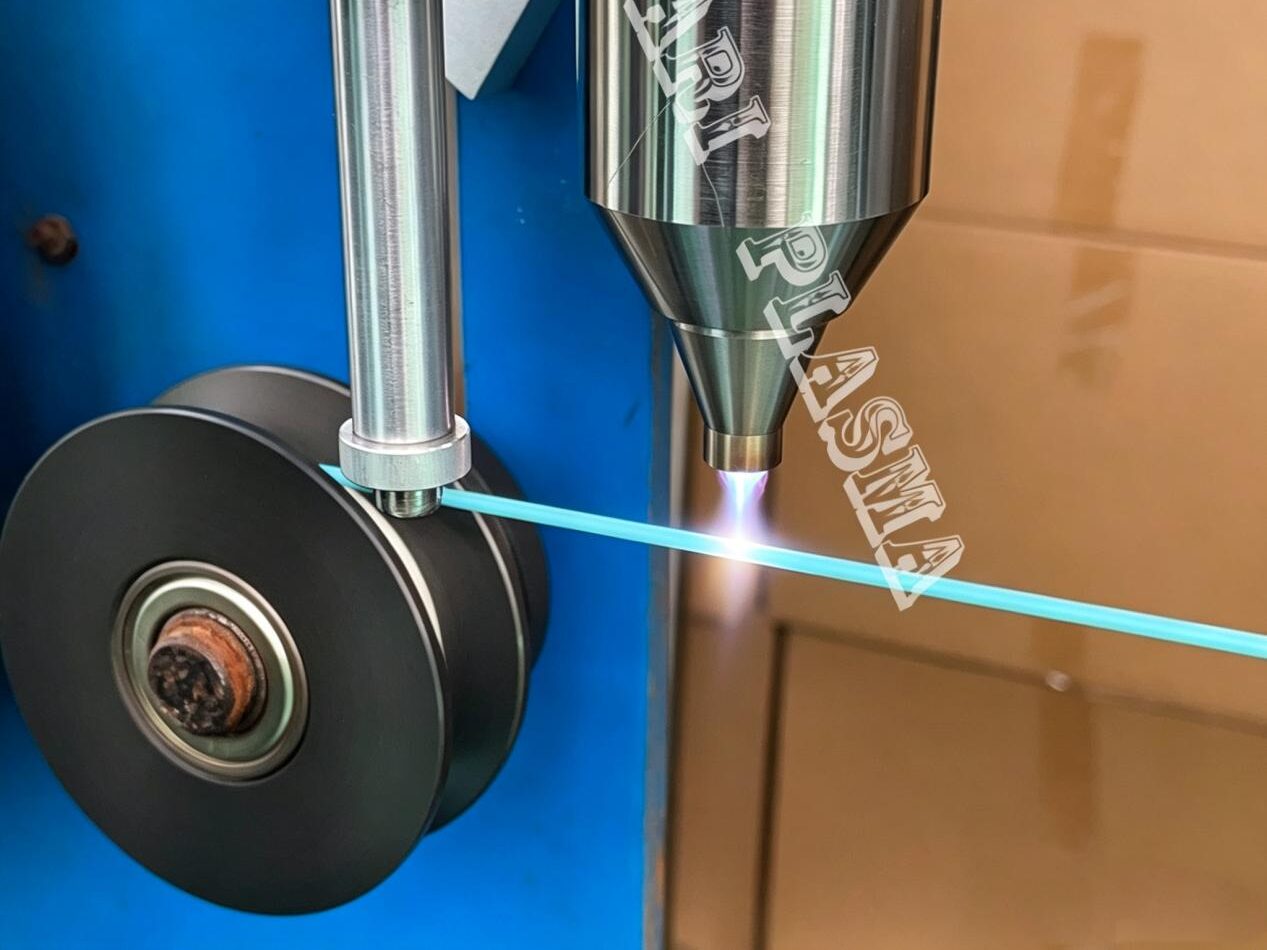
Atmospheric plasma treatment shows up wherever a surface needs to bond, print, or coat reliably before the next production step:
Selecting hardware starts with a handful of practical questions: how fast the line moves, how wide the substrate or web is, which gas the process calls for, and how the plasma head needs to integrate with existing conveyors or automation controls. Getting these right up front avoids retrofitting a system that was sized for a different job.
Fari's atmospheric plasma systems come in nozzle, rotary, and conveyor formats; two catalog configurations cover most inline needs: the inline conveyor atmospheric plasma system for parts moving on a conveyor, and the low-temperature inline atmospheric plasma system for heat-sensitive substrates that can't tolerate a hot discharge. Both can be configured as catalog units or adapted through OEM/ODM engineering for a specific line layout — contact Fari Plasma to walk through which configuration fits a given production setup.
Is cold atmospheric plasma good for aging skin? Cold atmospheric-pressure plasma is studied in dermatology and cosmetic research as a topic in its own right, but this is not a claim Fari Plasma makes about its equipment — the systems described here are built for industrial surface cleaning and activation, not medical or cosmetic skin treatment, and no efficacy or safety claims for skin applications are made.
Can you physically touch plasma? Some low-power, cold plasma jets used in research settings can be briefly contact-safe under controlled conditions, but industrial atmospheric-pressure plasma treatment systems are not designed for direct human contact. They should always be operated according to the equipment's safety guidelines and interlocks.
Is there plasma in our atmosphere? Yes — naturally occurring plasma exists in phenomena like lightning and the ionosphere, high above ground level. Industrial atmospheric-pressure plasma is a different, man-made version: it's generated and controlled at ground level, at ordinary ambient pressure, using electrodes and a power supply rather than natural atmospheric energy.
Can air be turned into plasma? Yes. When enough voltage is applied across a gap in air (or another gas), the electric field strips electrons from gas molecules and ionizes it into plasma. This is the basic principle behind atmospheric plasma treatment systems, which typically use compressed air as the process gas.
What is cold atmospheric plasma? Cold atmospheric plasma is plasma generated near room temperature rather than at high heat, because the electrons carry most of the energy while the surrounding gas stays comparatively cool. That temperature control is what allows treatment of heat-sensitive materials like plastics, films, and electronic components without thermal damage.
Is atmospheric plasma spray the same as atmospheric plasma treatment? No. Plasma spray is a thermal coating process that melts and deposits material onto a surface to build up a coating layer. Atmospheric plasma treatment (cleaning and activation) modifies the existing surface chemistry and energy without adding any material or coating.
What is an atmospheric plasma treatment machine? It's equipment that generates atmospheric-pressure plasma inline — through a nozzle, jet, or rotating head — so parts or webs can be cleaned and surface-activated continuously as part of a production line, rather than in a batch chamber. Catalog and custom configurations are available through product pages built for conveyor and web integration.
Have a specific line speed, substrate, or gas requirement to work through? Get in touch with Fari Plasma for a technical evaluation of which configuration fits.



English

Spanish
Rogatus ad ultimum admissusque in consistorium ambage nulla praegressa inconsiderate