If your corona treatment system can’t deliver consistent adhesion on 3D parts, keeps generating ozone extraction headaches, or simply won’t let you tune the surface chemistry beyond basic oxidation, it’s not broken — it’s just reached its ceiling. Plasma treatment (atmospheric or low-pressure) picks up exactly where corona leaves off: deeper surface activation, process gas flexibility, and uniform treatment on geometries that corona was never designed to handle. This post gives you a straight comparison so you can decide whether upgrading makes financial and technical sense for your specific production scenario — or whether corona is still the right tool for the job.
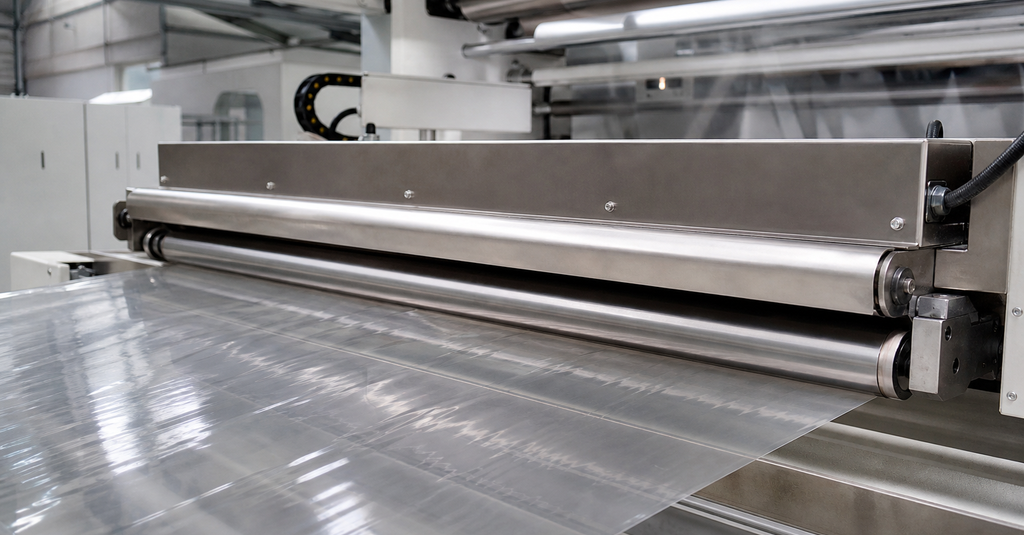
Let’s get this out of the way: corona treatment is a proven, cost-effective technology. For treating flat polymer films and sheets inline at high speed, it’s hard to beat. A corona station on a flexographic printing line or a blown-film extrusion line does exactly what it needs to do — raise surface energy enough for ink adhesion — and it does it cheaply.
The problems start when you ask corona to do things it was never engineered for:
If any of these limitations sound familiar, you’re not dealing with a broken system — you’re dealing with a technology mismatch.
Plasma treatment works on the same fundamental principle as corona — energized gas species modify the top molecular layers of a surface — but with dramatically more control. Think of corona as a sledgehammer and plasma as a scalpel. Both hit the surface, but one lets you choose exactly how.
This is the single biggest differentiator. With atmospheric plasma, you can feed oxygen for aggressive oxidation, nitrogen to graft amine groups (critical for certain adhesive chemistries), or forming gas for reduction reactions. Low-pressure plasma opens the door even wider: argon for gentle cleaning, CF₄ for fluorination, ammonia for biocompatibility treatments. Each gas produces different functional groups on the surface, which means you can engineer adhesion rather than just hope for it.
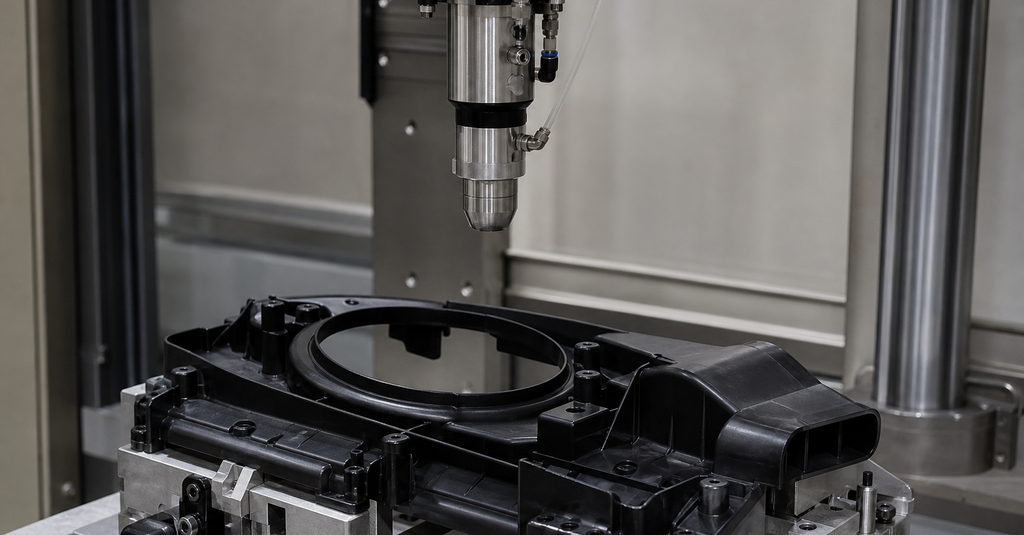
Atmospheric plasma jets and rotating nozzles can follow robotic paths across 3D contours. Low-pressure plasma surrounds the entire part in a vacuum chamber, treating every exposed surface simultaneously — including internal channels and undercuts that no line-of-sight technology can reach. Explore our full range of surface treatment capabilities to see what geometries we handle routinely.
Plasma-treated surfaces commonly reach contact angles below 20° (atmospheric) or below 15° (low-pressure), and the activation persists longer because the functional groups are more uniformly distributed and more deeply integrated into the surface layer. For production lines where parts sit in inventory before bonding or coating, this shelf-life advantage alone can eliminate reject batches.
A European flexible packaging converter ran corona treatment on their BOPP film line for years without issues — until a major CPG customer demanded solvent-free lamination with water-based adhesives. The existing corona station could raise surface energy to ~42 mN/m, but the new adhesive chemistry required consistent 50+ mN/m across the entire web width.
They tried cranking up the corona power. Result: pinholing from excessive discharge intensity at the film edges, plus ozone levels that triggered their extraction system’s capacity alarm. The fix wasn’t more corona — it was a different technology. They retrofitted an atmospheric plasma unit with nitrogen-enriched process gas directly upstream of the lamination nip. Surface energy jumped to 54 mN/m, edge-to-edge uniformity improved to ±1.5 mN/m, and ozone generation dropped to near zero.
The capital cost was roughly 3× the original corona station. The payback? Under 14 months, driven entirely by eliminated lamination defects and reduced adhesive consumption (because the adhesive actually wet the surface properly on the first pass).
Stop thinking of these as competing technologies — they’re a spectrum. Each one occupies a sweet spot defined by part geometry, throughput requirements, required surface chemistry, and budget. The comparison table above gives you the data at a glance, but here’s the decision logic behind it.
For a deeper dive into how atmospheric and low-pressure systems differ, check our technology and knowledge hub.
Here’s what rarely shows up in the corona-vs-plasma cost comparison: the cost of not upgrading. These are real line items that production managers often attribute to other root causes.
When surface energy is borderline, operators compensate by applying more adhesive, more primer, or more coating. A 15–20% adhesive overuse rate is common on lines where the surface treatment is marginal. At industrial adhesive prices ($8–$25/kg depending on chemistry), that adds up fast.
Corona treatment decay is unpredictable. Parts treated on Friday and bonded on Monday may fail quality checks. If your reject rate on bonded assemblies exceeds 2–3%, surface treatment is almost certainly a contributing factor — especially if failures cluster around parts with longer dwell times between treatment and bonding.
Many manufacturers apply primer as an insurance policy because their corona treatment isn’t reliable enough to guarantee direct adhesion. Plasma activation strong enough to bond directly to untreated polyolefins, fluoropolymers, or glass-filled composites can eliminate the primer step entirely — saving material cost, drying time, and floor space. One automotive Tier-1 supplier we’ve worked with eliminated two primer stations from a dashboard assembly line after switching to inline atmospheric plasma.
Ozone extraction systems consume energy, require filter maintenance, and need periodic compliance verification. In regions with tightening workplace air quality standards (EU Directive 2017/164, OSHA PEL updates), the ongoing cost of corona-related ozone management is trending upward, not downward.
Don’t take anyone’s word for it — including ours. Run a structured evaluation before committing capital. Here’s the process we recommend:
Measure contact angles on your treated surfaces at the point of treatment and at the point of bonding/coating. If there’s a significant gap (more than 10° decay), treatment longevity is a problem. If the initial contact angle never drops below 35°, you’re leaving activation performance on the table.
What functional groups does your adhesive or coating actually need? Hydroxyl? Carboxyl? Amine? If you don’t know, your adhesive supplier does — ask them. This determines which process gas you’ll need, which in turn determines whether atmospheric or low-pressure plasma is the better fit.
Any credible plasma equipment supplier will run sample parts through their systems and provide before/after contact angle data, XPS surface analysis, or adhesion pull-test results. At fariplasmatech, we do this routinely through our application testing services — send us your substrates and your target specs, and we’ll tell you exactly what’s achievable.
Compare the plasma system cost (equipment + installation + gas supply + maintenance) against the savings from eliminated primers, reduced adhesive consumption, lower reject rates, and removed ozone extraction. In our experience, the break-even point for most industrial applications falls between 8 and 24 months.
A medical device manufacturer producing catheter assemblies had been using corona treatment to improve bonding between PTFE tubing and polyurethane hubs. Corona got them to a 70% first-pass yield on pull tests. The other 30% required manual rework — re-treating, re-bonding, re-testing — at enormous labor cost and with full traceability documentation for each reworked unit.
They switched to low-pressure plasma with an oxygen/argon gas mixture. Contact angles on the PTFE dropped from 108° (untreated) to 22° — corona had only managed 65°. First-pass yield jumped to 97%. The rework labor savings alone covered the plasma system cost in 11 months, and the chamber-based process gave them the batch traceability records their ISO 13485 quality system demanded.
This is a textbook case of corona being adequate for years until quality requirements, material changes, or regulatory expectations push past its capabilities. If you’re in a regulated industry, visit our applications page to see how plasma addresses compliance-driven surface treatment challenges.
Upgrading from corona to plasma isn’t plug-and-play, but it’s not a full line redesign either. Here’s what to plan for.
An atmospheric plasma nozzle or array typically occupies a similar footprint to a corona station. The main additions are a process gas supply (compressed nitrogen or oxygen cylinders, or a generator) and a plasma power supply unit that may require a dedicated electrical circuit. Robotic integration adds complexity but also enables selective treatment — activating only the bonding zone rather than the entire part surface.
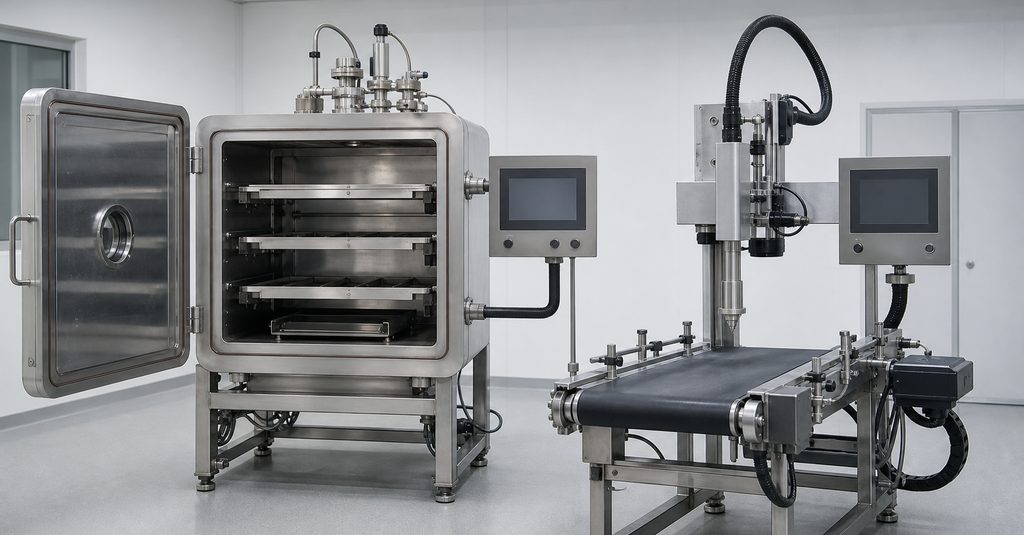
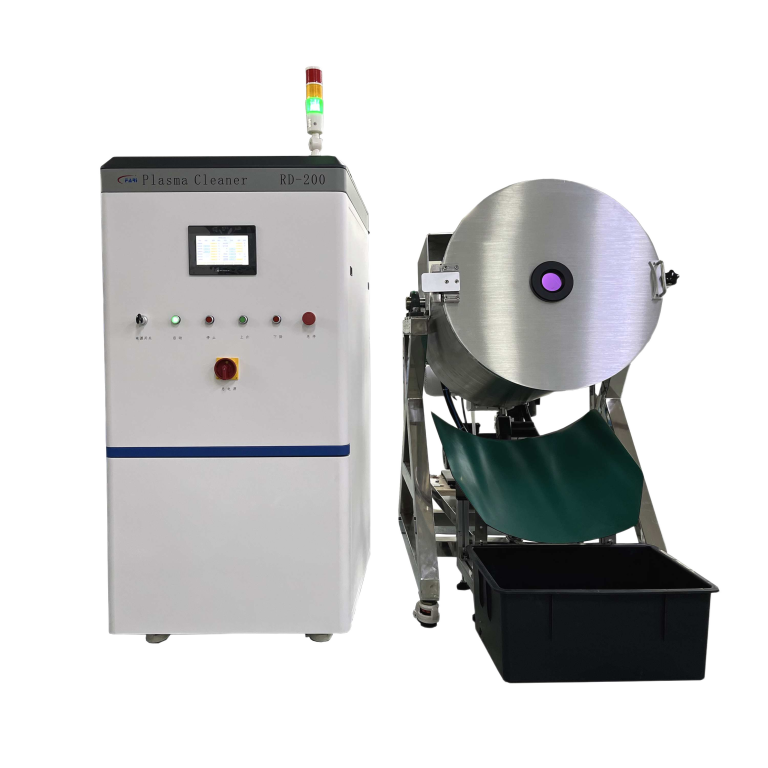
These require a vacuum chamber, vacuum pump, gas delivery system, and a control unit. The chamber size dictates your batch capacity. Cycle times typically run 1–10 minutes depending on the process recipe. For high-volume production, multiple chambers or a semi-continuous load-lock design can maintain throughput. The floor space requirement is larger than atmospheric plasma but often smaller than the combined footprint of a corona station plus its ozone extraction ducting.
Modern plasma systems offer recipe-based control, data logging, and integration with MES/SCADA systems. If your corona station is a simple on/off with a power dial, the jump to plasma also represents a jump in process control maturity — which is increasingly a customer audit requirement, not just a nice-to-have.
Before you call a supplier, run through this list. If you check three or more boxes, corona is likely holding you back.
If most of these don’t apply and you’re running flat-web converting at high speed, corona is probably still your best bet. No need to over-engineer the solution. But if three or more resonate, it’s time for a serious evaluation.
Ready to find out what plasma can do for your specific substrates and process? Get in touch with our applications team — we’ll start with your parts, your specs, and your production reality, not a generic sales pitch.




English

Spanish
Rogatus ad ultimum admissusque in consistorium ambage nulla praegressa inconsiderate