
Acrylic (PMMA) is widely used for UV printing, screen printing, vacuum coating, optical parts, displays, and bonded assemblies. Yet many processors face the same frustrating problem: ink looks fine at first but peels from solid-color or dark-gradient areas, especially after handling or environmental exposure. Cleaning with alcohol, adding primer, or changing ink often treats the symptom without removing the real cause.
This case study explains how vacuum plasma treatment prepares acrylic sheets for printing, coating, film lamination, and bonding. The process combines dry molecular cleaning with shallow surface activation, helping manufacturers improve wetting and adhesion without solvents, liquid residue, or high-temperature damage.
PMMA typically has a surface tension of about 34–38 mN/m. UV inks, optical adhesives, and coating materials usually need a higher-energy surface to wet evenly; practical production often targets at least 38–42 mN/m for reliable wetting, while stronger chemical bonding may require more than 50 mN/m. This gap is one reason ink can shrink at the edges, form weak spots, or peel after curing.
Mold-release agents from injection molding or extrusion, residue left after protective-film removal, polishing wax, machining dust, and static-attracted particles may be only nanometers to micrometers thick. They are difficult to see but can sit directly between the acrylic and the ink, adhesive, or coating. Wiping the surface may remove visible dirt while leaving a thin organic film behind.
Alcohol, acetone, and aggressive cleaners can penetrate cut edges, drilled holes, or bent areas of acrylic. On cast sheets with higher internal stress, repeated wiping may promote crazing and whitening. A process that solves contamination but creates solvent-related damage is not a stable production solution.
PMMA has a glass-transition temperature of roughly 105 °C and a heat-deflection temperature just above 90 °C. Local heating can cause warpage or yellowing, particularly on thin sheets and large panels. Flame treatment and high-temperature baking therefore provide limited process flexibility for precision acrylic parts.
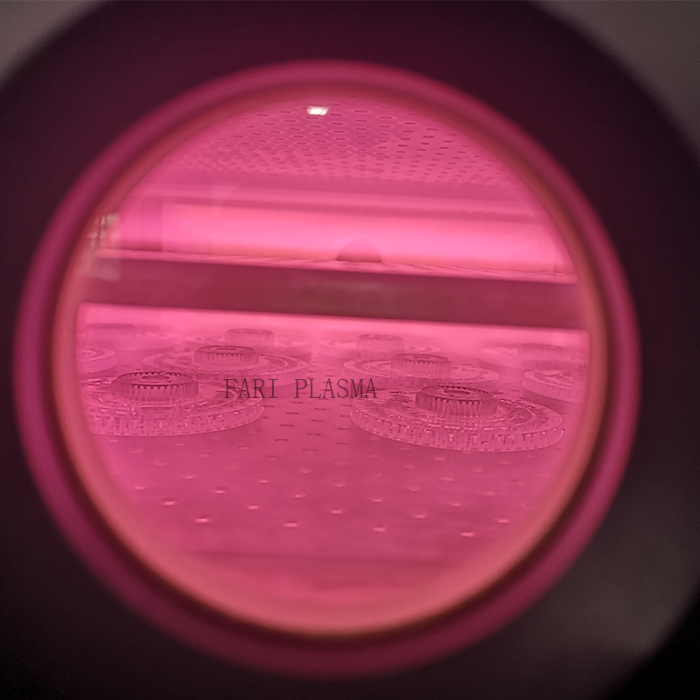
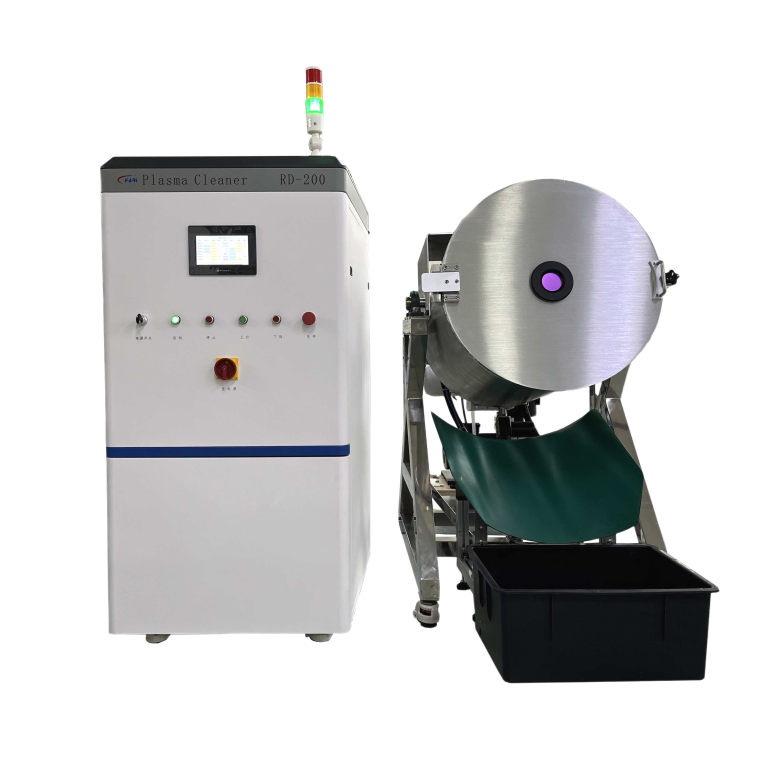
The chamber is evacuated to the selected working pressure and filled with a process gas. An RF electric field ionizes the gas, creating a mixture of electrons, ions, radicals, metastable species, and photons. Although the plasma contains energetic species, it is a cold-plasma process with a controlled macroscopic temperature, making it suitable for temperature-sensitive acrylic.
Energetic species break down organic contaminants. Oxygen radicals can oxidize hydrocarbon residues into volatile products such as carbon dioxide and water, which are removed by the vacuum system. Argon ions add physical bombardment for inorganic dust and salt residues. Because the mean free path is longer at low pressure, the plasma can reach grooves, hole walls, and engraved textures that are difficult to clean with a wipe or a line-of-sight flame.
After contamination is removed, the fresh acrylic surface can be functionalized with polar groups such as –OH, C=O, and –COOH. In the documented case, surface energy increased from about 34 mN/m to 54–72 mN/m, while water contact angle decreased from approximately 75° to below 20°. Ink, adhesive, and coating materials can then spread more evenly and form stronger interfacial interactions.
Vacuum plasma modifies only a shallow surface layer, typically from a few nanometers to several tens of nanometers. The bulk acrylic remains unchanged, so optical transmission, haze, color, and mechanical properties can be preserved when the recipe is properly controlled. The treatment is dry and contactless, which avoids the liquid penetration and mechanical pressure associated with solvent wiping.
For temperature-sensitive work, chamber temperature can be controlled below 60 °C in the described process. This keeps the part well away from the material’s heat-deflection range. As with any surface process, power, time, gas chemistry, part spacing, and fixture design should be validated on the actual sheet grade and geometry.
Manufacturers comparing process options can also review our guides to plasma surface treatment, plasma activation, cleaning, and etching, and atmospheric versus low-pressure plasma production lines.
Not when the recipe is matched to the material and over-treatment is avoided. The case data reports haze change of no more than 0.3% and color difference below ΔE 0.5. Excessive power, excessive time, and local heat accumulation are the main risks to control.
The activated surface gradually adsorbs organic molecules from the air and can lose energy over time. Printing, bonding, or coating within 24 hours is recommended, and the interval should generally not exceed 72 hours. If immediate processing is not possible, store treated parts in a clean bag or under a protective film.
Yes. Low-pressure plasma has good reach into hole walls, recesses, and engraved textures. Blow off machining dust before loading the chamber so loose particles do not become a secondary contamination source.
The dry, low-temperature process does not expose the part to liquid or mechanical pressure. Flat support, suitable power and time, and correct spacing are important. For ultra-thin or oversized sheets, a temperature-controlled tray can provide additional protection.
Vacuum plasma does not add mechanical stress or cause swelling. Replacing repeated solvent wiping may actually reduce the risk of edge crazing caused by solvent exposure.
Over-activation can increase film adhesion and may leave residue. If the next step requires clean removability, reduce power or treatment time and validate peel force. The target is a surface energy high enough for printing but not so high that it locks the temporary film in place.
Capacity depends on chamber size, part dimensions, and loading layout. Small parts can often be arranged in batches, with a typical cycle of about 5–10 minutes. Exact throughput should be calculated from the actual parts and production takt time. Explore FARI Plasma equipment options or contact the application team for a process review.
No chemical bath or liquid waste is required. The process uses electricity and a selected process gas, such as compressed air, oxygen, or argon. Operating cost is mainly associated with power and gas consumption.
For acrylic processors, the most reliable way to solve recurring ink, coating, film, or bonding failures is to control both contamination and surface energy. Vacuum plasma provides a dry, low-temperature route that cleans at the molecular level and activates the PMMA surface in one controlled step. With recipe validation and prompt downstream processing, it can improve adhesion while protecting the appearance and dimensional stability of acrylic parts.


English

Spanish
Rogatus ad ultimum admissusque in consistorium ambage nulla praegressa inconsiderate