
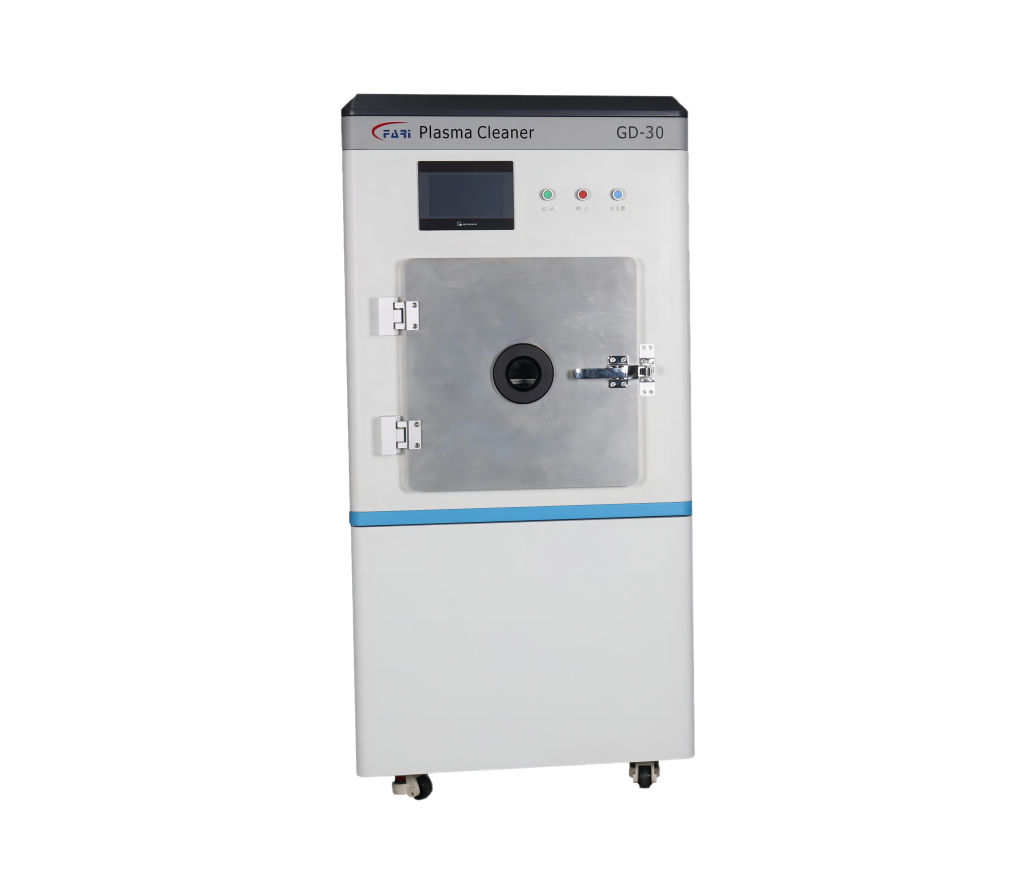
A plasma cleaner turns ordinary gas into a reactive, ionized state and directs it at a material surface to remove contaminants or raise surface energy — without water, solvents, or wiping. Engineers usually reach for one when a bond, coating, or ink layer that should adhere suddenly doesn’t, and the culprit turns out to be dust, oils, or mold-release residue sitting on the part at a scale manual cleaning can’t reach.
A plasma cleaning device generates plasma — a gas given enough electrical energy to separate into ions, electrons, and reactive neutral species — and directs it at a surface inside a controlled environment. Every unit shares the same building blocks: a power supply that delivers the electrical energy, a gas delivery system that meters the process gas, a chamber or nozzle where the plasma forms and contacts the part, and a control system that manages the sequence.
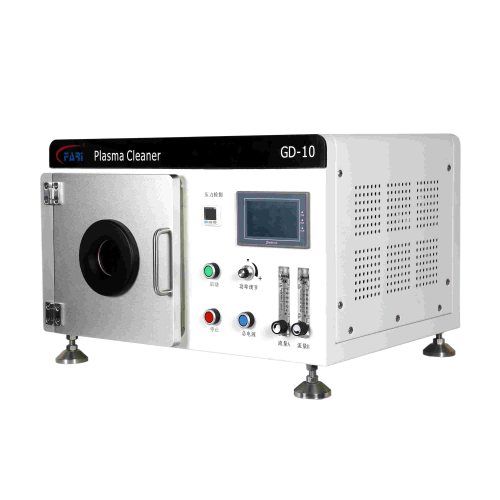
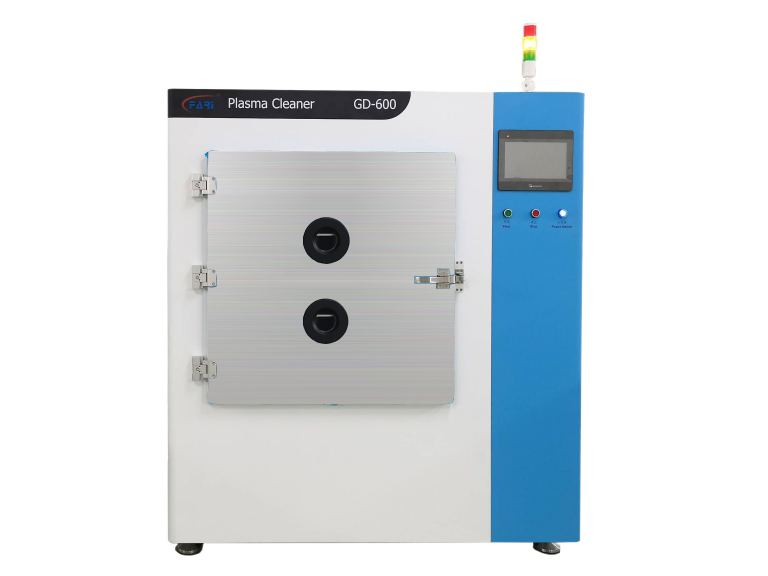
The device is the equipment; plasma cleaning is what happens on the surface once it runs. Sealed vacuum chambers pull down to low pressure before striking plasma, a design that suits complex geometries and batch loads — high-power vacuum plasma systems are built for that kind of deep, uniform treatment. Open-air nozzles strike plasma at normal pressure, a design suited to continuous inline processing.
A plasma cleaner changes a surface at the molecular level rather than just removing visible dirt. Depending on gas and settings, the same equipment can produce:
Argon ion bombardment favors etching, oxygen chemistry favors cleaning and ashing, and nitrogen plasma favors activation without surface roughening; the plasma gas selection guide breaks down each gas’s effect on specific materials. Against solvent wiping, this dry process leaves no liquid waste and produces the same result cycle after cycle, though it depends on electrical infrastructure and, for vacuum types, a chamber cycle rather than a rag and a bottle.
The sequence is consistent across equipment types: gas enters the chamber or nozzle, electrical energy ionizes it into plasma, and the resulting ions, electrons, and free radicals strike the surface, breaking down contaminants and altering surface chemistry. Vacuum systems pump the chamber down before striking plasma, which is what makes their treatment so even across recessed and complex geometries. Atmospheric systems strike plasma at ambient pressure and rely on the part’s motion past the nozzle for coverage.
Surface energy gains from activation aren’t permanent. They typically fade over hours to days as the surface reorganizes or picks up airborne contamination again, which is why parts are normally bonded, coated, or printed shortly after treatment rather than stored in a treated state.
Troubleshooting fade and inconsistent results:

Vacuum plasma cleaners run inside a sealed, evacuated chamber, which delivers highly uniform treatment across complex or recessed geometries at the cost of a load/evacuate/vent cycle per batch. Atmospheric plasma cleaners generate plasma at normal pressure through a nozzle, suited to parts moving continuously past the treatment zone on a line.
| Factor | Vacuum plasma cleaner | Atmospheric plasma cleaner |
|---|---|---|
| Operating pressure | Sealed chamber, pumped down before plasma strikes | Ambient pressure, plasma struck in open air |
| Cycle time | Batch — load, pump down, treat, vent, unload per load | Continuous — parts treated as they move past the nozzle, no dwell cycle |
| Uniformity | High and even across recessed or complex geometries | Strong on the face directly under the nozzle path |
| Footprint | Larger — chamber, pump, and vacuum lines | Smaller — nozzle head and generator, easier to mount inline |
| Typical cost driver | Chamber size and vacuum pump capacity | Nozzle count/width and line-speed matching |
Neither type is universally better — the right pick depends on part geometry, batch size, and how the equipment fits into production. Once that’s clear, browse the plasma cleaner equipment lineup for both vacuum and atmospheric configurations.
The plasma cleaner applications by industry page maps the full set of materials and processes; the recurring pattern looks like this:
Two concrete examples: Plasma treatment for lithium battery manufacturing prepares electrode and casing surfaces before assembly, and PP toy plasma treatment for better printing & bonding gets consistent ink and adhesive adhesion on polypropylene parts that would otherwise resist both.
Four factors decide the shortlist:
Budget shapes the shortlist too. Plasma cleaner cost outlines the typical price drivers for benchtop, batch chamber, and inline board-level equipment, and the plasma cleaning chamber guide addresses chamber-style vacuum equipment specifically, from sizing to component layout. For help applying these criteria to a specific part, contact us.
What is the difference between plasma cleaning and plasma etching?
Cleaning removes surface contaminants with minimal material loss; etching intentionally removes material layers through chemical reaction and ion bombardment to build microstructures or strip films. Both rely on the same underlying mechanism run at different intensities, detailed in activation vs. cleaning vs. etching.
What is the difference between plasma cleaning and plasma ashing?
Ashing is a specific, oxygen-driven form of plasma treatment used mainly in semiconductor work to strip photoresist and organic films completely, rather than just removing surface contamination. General cleaning is milder and aims to leave the underlying material intact.
What is the difference between plasma cleaning and corona treatment?
Corona treatment uses a high-voltage discharge in open air and is common on fast-moving films and webs, while plasma cleaning can run in a controlled vacuum or atmospheric setup for more uniform, tunable results — see corona vs. plasma treatment: when to upgrade for where each fits.
Is plasma cleaning safe to run in a standard production facility?
It’s a dry, solvent-free process that avoids the chemical handling and disposal concerns of liquid cleaning. Like any electrically powered industrial equipment, it should be operated per the manufacturer’s instructions and facility electrical/gas-handling practices.
Can plasma cleaners treat metals, glass, and ceramics, or only plastics?
Plastics get the most attention because their low surface energy makes bonding difficult, but plasma also cleans and activates metals, glass, ceramics, and electronic substrates, since the process alters surface chemistry rather than relying on solvent solubility.
Does a plasma cleaner need special process gas, or can it run on shop air?
Many systems run on compressed air for general cleaning and light activation. Oxygen, nitrogen, or argon cylinders are used when a process calls for a specific chemical effect, such as stronger activation, etching, or ashing.
—
A plasma cleaner prepares or cleans a surface using energized gas instead of liquid chemistry, and the right configuration depends on part geometry, batch size, and how much surface-energy gain a bond or coating actually needs. To have a specific part evaluated with a sample treatment, contact us.


English

Spanish
Rogatus ad ultimum admissusque in consistorium ambage nulla praegressa inconsiderate